
Selecting WPC wall panels for gyms requires more than choosing a color that works with the logo. Fitness facilities expose wall finishes to fingerprints, sweat, dust, shoe marks, cleaning carts, movable benches, and frequent maintenance. At the same time, the interior must communicate the character of the business from the moment a member enters the reception area.
For gym owners, commercial designers, fit-out contractors, and wholesale buyers, the right wall system must balance surface care, daily durability, installation planning, brand consistency, and long-term cost. Latitude Interiors Limited supplies WPC wall panels in several dimensions and decorative directions, providing a practical starting point for commercial fitness center wall design.
Are WPC Wall Panels Suitable for Fitness Centers?
WPC wall panels can be suitable for reception desks, membership areas, corridors, cardio zones, yoga studios, Pilates rooms, and selected changing-room walls. These areas benefit from a finished surface that can support routine cleaning while giving the interior more visual structure than painted drywall alone.
Application must still be assessed by zone. Decorative WPC panels are not a replacement for tested safety padding or heavy-duty protective barriers in free-weight areas, medicine-ball stations, or high-contact training spaces.
| Fitness center area | Recommended approach |
|---|---|
| Reception and membership desk | WPC feature wall with signage and controlled lighting |
| Cardio area perimeter | WPC panels with a confirmed cleaning procedure |
| Yoga or Pilates studio | Light or warm-toned panels with low visual contrast |
| Main corridor | WPC panels with corner and lower-wall protection where needed |
| Dry changing area | WPC panels after moisture and ventilation review |
| Free-weight zone | Dedicated wall guards or specialist protective systems |
| Medicine-ball station | Tested impact surface rather than decorative panels |
This zone-based approach prevents a common specification error: treating every gym wall as if it faces the same level of contact.
Daily Wear, Scuffs, and Surface Protection
Durable wall panels for gyms must cope with repeated low-level contact. Members place bags against walls, foam rollers lean in corners, benches are moved during cleaning, and maintenance carts pass through narrow corridors. Shoe marks and handprints also collect around doors, mirrors, lockers, and drinking stations.
These conditions are different from direct impact by weights or exercise equipment. A decorative wall panel may handle normal contact when correctly specified and installed, but it should not be expected to absorb dropped plates, kettlebell strikes, or repeated ball throws.
Wall protection should be planned around the equipment layout. Lower-wall guards, corner profiles, kick plates, or protective rails can be installed in higher-risk locations. Equipment should also be positioned with sufficient clearance from finished walls. This reduces damage without covering every surface with industrial protection.
For gym wall panels in high-traffic areas, the edge details often matter as much as the panel face. Internal corners, external corners, door frames, mirror junctions, and skirting lines should be resolved before installation begins.
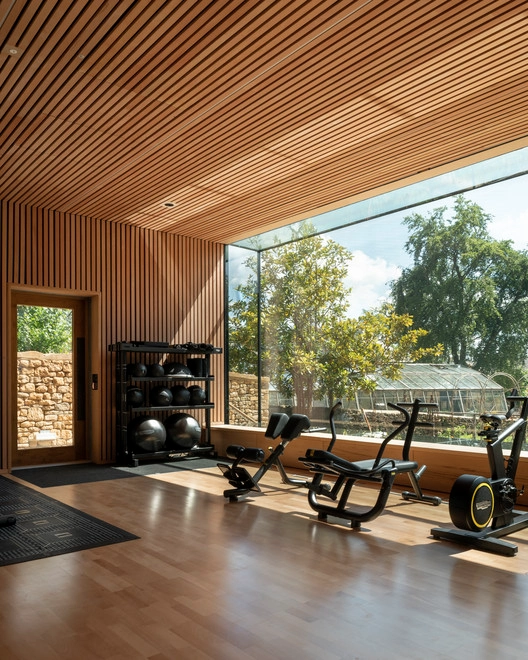
Cleaning Sweat, Handprints, and Gym Dust
Easy-to-clean gym walls still require a controlled maintenance plan. Sweat, skin oils, fingerprints, chalk dust, cleaning overspray, and shoe marks affect different parts of the wall. High-touch areas near studio entrances and mirrors may need attention several times a day, while upper feature-wall sections require less frequent care.
Loose dust should be removed before wet cleaning so that particles are not dragged across the finish. A compatible neutral cleaner is generally a safer starting point than a strong alkaline or solvent-based product. The exact cleaner should be tested on an approved wall panel sample or an inconspicuous area before facility-wide use.
Where disinfectants are required, staff must follow the product label, including surface compatibility and wet contact time. Excess liquid should not remain around joints, trims, electrical openings, or the base of the wall.
Low-maintenance wall panels are most effective when the supplier provides clear cleaning guidance and the facility records which products have been approved. Without that control, different cleaning teams may introduce chemicals that change gloss, leave residue, or affect the decorative surface.
Building the Brand Through Wall Design
Gym interior branding is more effective when the wall material supports the business model rather than simply repeating the logo color.
A strength-focused gym may use charcoal, dark wood, and low-gloss finishes to create a dense, performance-led atmosphere. Boutique fitness studios often benefit from lighter timber tones, warm neutrals, and fine vertical lines. Wellness clubs and hotel fitness rooms generally require quieter finishes that work with indirect lighting and mirrors.
| Fitness concept | Wall design direction |
|---|---|
| Strength and performance gym | Charcoal, dark wood, restrained gloss |
| Boutique fitness studio | Light wood, warm beige, fine grooves |
| Luxury wellness club | Warm timber tones and controlled feature lighting |
| Group exercise studio | Neutral panel base with focused brand-color accents |
| Yoga or Pilates studio | Pale wood and low-contrast natural colors |
| Hotel fitness room | Neutral, calm, and easy-to-maintain finishes |
Brand color does not need to cover every wall. A WPC panel can form the visual base, while illuminated signs, painted sections, mirror frames, or directional graphics carry the stronger color. This makes future brand updates less disruptive.
Latitude Interiors offers customized decorative options that can support reception walls, branded corridors, and studio entrances. Physical samples remain essential because screen images do not accurately show gloss, texture, or color under gym lighting.
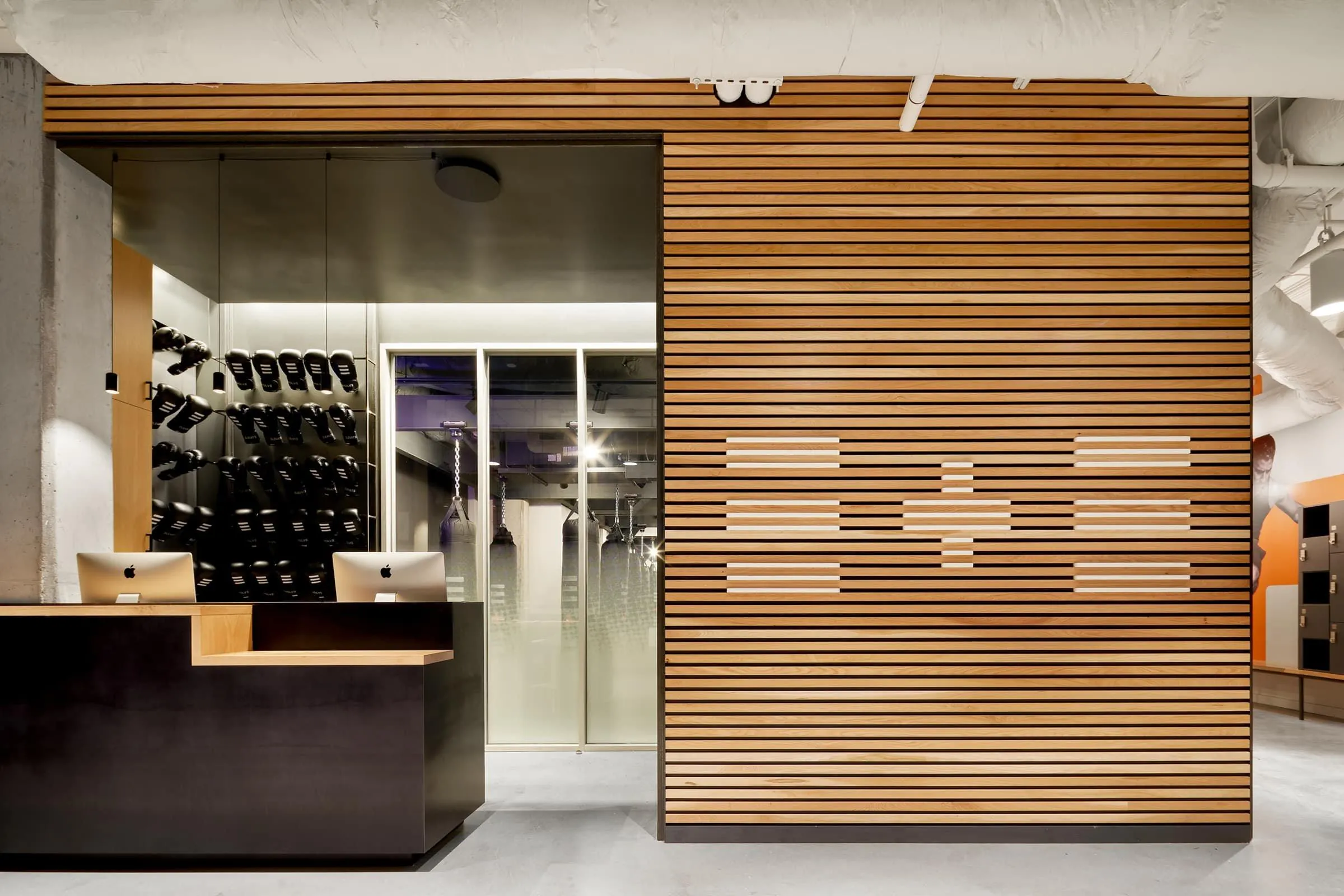
Planning a Faster Gym Renovation
Fast gym interior renovation depends on site preparation. Existing walls should be checked for flatness, moisture, loose coatings, damaged plaster, and unsuitable substrates. Mirrors, sockets, switches, door frames, skirting, ventilation openings, and equipment clearances also affect the panel layout.
A phased construction plan can reduce disruption. Reception work may be scheduled during low-traffic hours, studios can be renovated one at a time, and corridors can be divided into sections. Materials should be cut and labeled in advance where practical, especially when the facility remains partly operational.
Large-format panel dimensions may reduce the number of joints, but they also affect handling, access, cutting waste, and transport. These factors should be discussed before the order is confirmed rather than left for the installation team to resolve on site.
Understanding Maintenance and Lifecycle Cost
Gym wall panel maintenance cost extends beyond the initial panel price. A complete commercial estimate includes wall preparation, panels, trims, corners, fixing materials, cutting waste, installation labor, cleaning products, repairs, downtime, and replacement stock.
Repeated repainting may appear inexpensive at first, but labor, odor control, surface preparation, and area closures can increase long-term cost. Wall panels may offer better value where they reduce the frequency of cosmetic repairs, although that depends on the quality of the finish and the conditions of use.
Latitude Interiors describes commercial wall panel manufacturing and quality-control capabilities supported by a production base of more than 40,000 square meters, 25 production lines, an independent research laboratory, sample services, and quality inspection support. For chain fitness centers and wholesale projects, these capabilities are relevant to color coordination, repeat orders, packaging, and batch control.
Spare panels should be ordered with the main shipment and stored with their product code and approved sample. If a later replacement is sourced from a different batch, even a small color difference may become visible under directional lighting.
What Buyers Should Confirm Before Ordering
A commercial WPC wall panel specification should identify panel thickness, density, width, length, finish, installation method, substrate requirements, cleaning instructions, and approved chemicals. Buyers should also request fire, VOC, scratch, or other technical documents where required by the project.
Claims such as antibacterial, impact-resistant, chemical-resistant, or fire-resistant should be supported by documents for the exact SKU being purchased. A test report for another thickness or surface finish should not automatically be applied to the selected panel.
Latitude Interiors’ A010 customizable WPC wall panels for gym interiors are listed with density options of 0.65 and 0.75 ton/m³, thicknesses of 5 mm and 8 mm, widths of 900 mm and 1,200 mm, and lengths from 2,400 mm to 3,600 mm. These dimensions can support reception backgrounds, studio entrances, circulation walls, and branded feature areas.
The final color, surface finish, installation details, cleaning compatibility, technical documentation, minimum order quantity, and lead time should be confirmed through a physical sample and written product specification before bulk production.
Conclusion
WPC wall panels can provide a practical decorative solution for gym receptions, studios, corridors, and selected changing areas. Their value lies in combining a finished commercial appearance with manageable routine care and flexible brand design.
Successful specification depends on using the panels in appropriate zones. Everyday scuffs and cleaning demands should be separated from heavy equipment impact, which requires dedicated protective systems. Buyers should also review physical samples, cleaning compatibility, installation details, technical documents, and spare-stock requirements before placing an order.
Gym owners, contractors, designers, and distributors can request gym wall panel samples and specifications from Latitude Interiors for project-based review and commercial quotation.
Frequently Asked Questions
Q1: Are WPC wall panels good for gyms?
A: WPC wall panels can be suitable for gym receptions, corridors, studios, cardio areas, and selected changing-room walls. The panel finish, cleaning method, substrate, and expected level of contact should be reviewed before approval.
Q2: How do you clean WPC wall panels in a fitness center?
A: Loose dust should be removed first, followed by cleaning with a compatible product and soft cloth. Any disinfectant should be used according to its label. Abrasive pads, excess water, and unapproved chemicals should be avoided.
Q3: Can WPC wall panels handle gym equipment impact?
A: Decorative WPC panels may tolerate normal contact from bags, light accessories, benches, and cleaning carts, but they should not be used as protection against dropped weights, kettlebells, or repeated medicine-ball impact.
Q4: What wall panels are best for gym reception areas?
A: Gym reception wall panels should support brand colors, signage, lighting, routine cleaning, and consistent appearance across a large surface. Customized WPC panels may be considered after finish samples and technical requirements have been approved.
Q5: How much do gym wall panels cost to maintain?
A: Maintenance cost depends on cleaning frequency, approved products, repair needs, labor, downtime, and availability of matching replacement panels. A lifecycle calculation is more useful than comparing the panel price alone.


