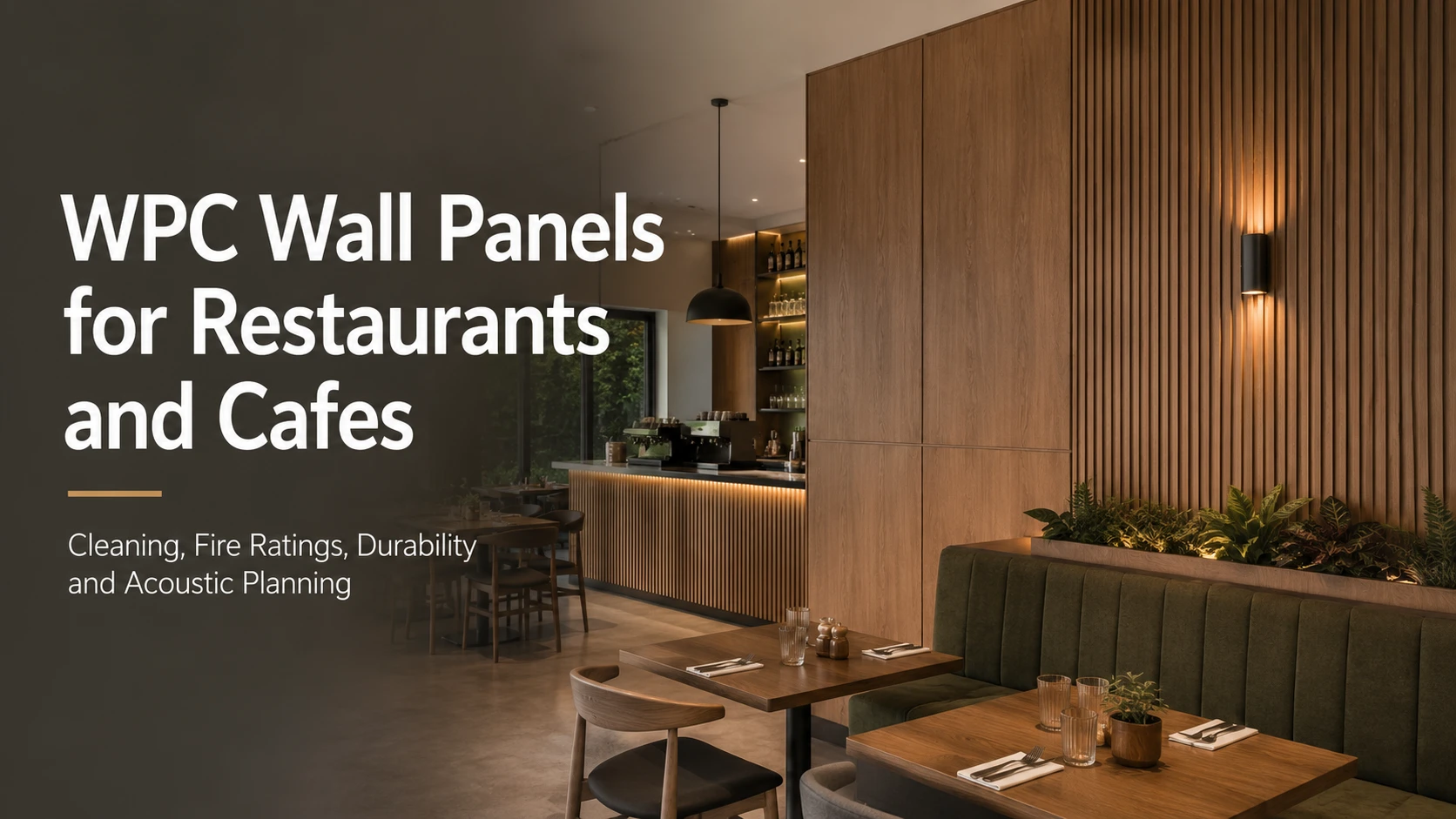
WPC wall panels for restaurants can suit dining rooms, waiting areas, feature walls, counter fronts, and selected corridors, but suitability depends on the exact zone. Grease exposure, cleaning chemicals, chair impacts, direct heat, washdown procedures, local fire requirements, and acoustic goals can change the specification. The practical approach is to divide the project by operating condition, then verify the finish, installation system, supporting documents, and replacement plan for each area.
Are WPC Wall Panels Suitable for Restaurants and Cafes?
Front-of-house and back-of-house walls face different cleaning, impact, heat, and hygiene conditions.
| Restaurant zone | Selection direction | Main checks |
|---|---|---|
| Dining room or feature wall | Often suitable for evaluation | Finish, cleaning method, fire documents |
| Waiting area | Often suitable for evaluation | Hand contact, luggage, chair impacts |
| Counter front | Project-dependent | Spills, edges, kick damage |
| Corridor | Project-dependent | Carts, corners, lower-wall protection |
| Food-preparation or washdown area | Usually needs a specialized system | Hygiene rules, heat, steam, joints |
The FDA Food Code distinguishes consumer-area decorative surfaces from walls in food-preparation and working areas, where smooth, nonabsorbent, easily cleanable finishes may be required. “Water-resistant” should not be treated as automatic approval for a restaurant kitchen or washdown zone.
Where WPC Panels Work Best in Front-of-House Areas
Dining rooms, cafe seating areas, logo walls, waiting zones, and decorative counter fronts are the clearest applications for restaurant WPC wall panels.
Divide each elevation into high-touch and low-touch areas. Check whether chair backs or carts will strike the lower wall, whether grooves can be reached by normal cleaning tools, and whether menus, screens, or lighting need structural support behind the decorative surface. Buyers comparing formats and finishes can review WPC wall panels for commercial interiors before requesting samples.
Where Decorative WPC Panels May Not Be the Right System
A decorative WPC panel should not be selected for a cooking line, dishwashing area, direct heat zone, or heavily washed service area only because it is described as waterproof. Cut edges, joints, trims, fasteners, cavities, and the substrate can create paths for moisture, grease, or contamination.
Where regular pressure washing, strong degreasers, continuous steam, or food-processing hygiene controls apply, a dedicated sanitary wall system may be more appropriate. Mark each zone on the drawings and state its cleaning exposure in the RFQ.
How Surface Design Affects Cleaning and Maintenance
Smooth, High-Gloss, or Fluted Panels: Which Finish Fits Each Zone?
Smooth or lightly textured panels are generally easier to wipe where handprints, beverage splashes, or frequent contact are expected. High-gloss finishes may allow simple surface cleaning, but they can also make fingerprints, scratches, lighting variations, and streaks more visible.
Fluted WPC wall panels can create a strong feature wall, yet deep grooves require more detailed dusting and spot cleaning. They are better placed away from oil mist, sauce splashes, or drink-preparation counters unless suitable cleaning tools are available.
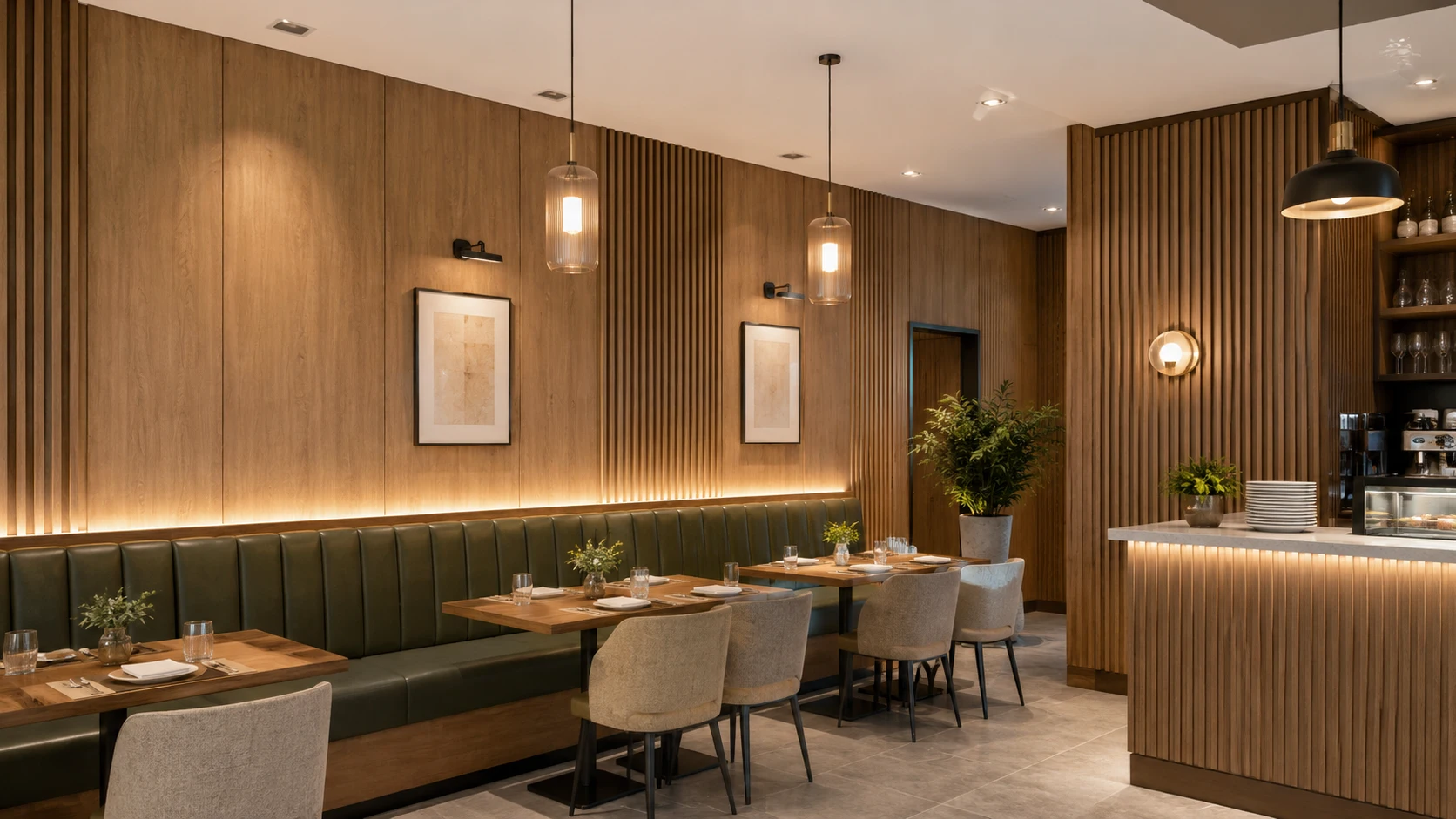
A sample of the high-gloss WPC wall panel for restaurant interiors can be reviewed as one decorative configuration. The listed A002 product offers 5 mm and 8 mm thickness options, 900 mm and 1,200 mm widths, and several length options. Final finish and application compatibility should be confirmed for the project.
Test Grease, Drinks, and Cleaning Chemicals Before Bulk Ordering
A sample test is more useful than a general “easy to clean” statement. Apply representative contaminants—such as coffee, sauce, grease, or a colored beverage—to an approved sample for a controlled period. Clean it using the restaurant’s intended product and method, then inspect for staining, gloss change, discoloration, residue in grooves, or edge damage.
Abrasive pads, strong solvents, or concentrated chemicals may affect some decorative films. Record the approved cleaner, dilution, contact time, and cleaning tool so the maintenance team can repeat the tested process.
How to Verify Fire Ratings for Restaurant Wall Panels
Verify the Exact Panel, Test Standard, and Installed System
“Fireproof,” “fire retardant,” and “fire rated” are not interchangeable purchasing terms. A useful document identifies the test standard, laboratory, tested product, thickness, surface construction, specimen preparation, mounting method, and results.
The International Building Code regulates interior wall and ceiling finishes by occupancy and location using flame-spread and smoke-developed criteria. It recognizes testing such as ASTM E84, UL 723, and, under specified conditions, NFPA 286. Mounting matters, so the architect or local authority should confirm which evidence is acceptable.
Request the complete report, confirm that its product code matches the quotation, and check whether adhesives, battens, cavities, or backing materials differ from the tested construction.
Durability, Impact Risks, and Panel Replacement
Plan for Chair Backs, Carts, Corners, and Lower-Wall Damage
Chair backs strike dining-room walls, carts pass through narrow corridors, luggage contacts waiting areas, and cleaning equipment clips exposed corners.
Map these risks before selecting panel height and layout. Corner trims, skirting, protective rails, or a different lower-wall material may reduce maintenance in high-impact zones. During sample review, inspect the face, edges, groove geometry, and finish under the project lighting. Do not infer an impact rating without product-specific data.
Plan Panel Replacement and Spare Stock Before Installation
Replacement difficulty depends on panel width, fastening method, installation direction, trims, and nearby fixtures. Color and gloss may also vary between batches, making a later repair visible.
Retain the approved sample, product code, finish reference, batch information, and installation drawing. Order spare material based on project size, vulnerable zones, cutting waste, and expected service period. Ask about minimum reorder quantities, product-change notification, and future matching stock.
Can WPC Wall Panels Improve Restaurant Acoustics?
Decorative WPC Panels Are Not Automatically Acoustic Panels
A wood-look or fluted decorative surface should not automatically be described as sound absorbing or soundproof.
ASTM C423 is used to measure sound absorption in a reverberation room, and NRC is commonly associated with this testing. Without data tied to the full construction and mounting method, decorative WPC should be treated as a finish rather than a verified acoustic product.
When a Decorative-and-Acoustic Hybrid System Makes Sense
A hybrid system may suit open dining rooms where the design calls for a wood-look feature and the acoustic plan requires tested absorption. The decorative face may be combined with an acoustic backing, cavity, or separate absorptive areas, but the complete assembly should be evaluated.
Request the test method, mounting configuration, backing material, coverage area, fire documentation, and cleaning instructions. Large or complex spaces may require an acoustic consultant to determine placement and quantity.
Restaurant WPC Wall Panel Selection and Supplier Review
Provide wall elevations, restaurant type, application zones, area and height, substrate, cleaning frequency, contamination risks, impact routes, installation date, desired finish, sample requirements, and estimated quantity.
The supplier response should identify the product, dimensions, thickness, finish, edge details, trims, packing, installation guidance, relevant test documents, and spare-material options. Compare quotations on the same scope.
Latitude Interiors presents WPC and SPC wall panels and flooring for interior projects, while about Latitude Interiors provides background information for supplier review. The restaurant-focused A002 page lists a high-gloss decorative WPC panel with defined size options, but suitability for cleaning exposure, fire requirements, impact risk, and acoustic goals should still be verified in writing.
Conclusion
WPC wall panels for restaurants and cafes are most convincing in front-of-house areas where decorative appearance, routine cleaning, and controlled contact are the main requirements. They should not be specified across every zone without checking hygiene, heat, chemicals, fire documentation, impact routes, and acoustic performance.
For a project review, submit wall elevations, application zones, finish and size requirements, cleaning conditions, required documents, sample needs, quantity, installation schedule, and photos of existing damage through request restaurant wall panel samples. Latitude Interiors can then review available configurations against the stated conditions.
Frequently Asked Questions
Are WPC wall panels easy to clean in restaurants?
They can be easy to maintain in controlled front-of-house areas, but results depend on the finish, groove depth, stain type, cleaner, and cleaning frequency. Test the actual sample before bulk ordering.
Can WPC wall panels be used in a commercial kitchen?
Do not decide based on water resistance alone. Cooking, dishwashing, steam, grease, and washdown areas may require smooth, sealed, easily cleanable systems that meet local requirements.
Are WPC wall panels fireproof?
A general fireproof claim is not sufficient. Request a report for the exact panel, thickness, finish, and mounting system, then have the project professional confirm code compliance.
Do WPC wall panels reduce restaurant noise?
Not automatically. Acoustic performance should be supported by test data for the complete construction. Without such data, treat standard WPC as a decorative finish.
Are fluted WPC wall panels difficult to clean?
Deep grooves usually require more detailed dusting and spot cleaning than smooth panels. They are generally better placed away from grease-heavy or frequent-splash areas.