
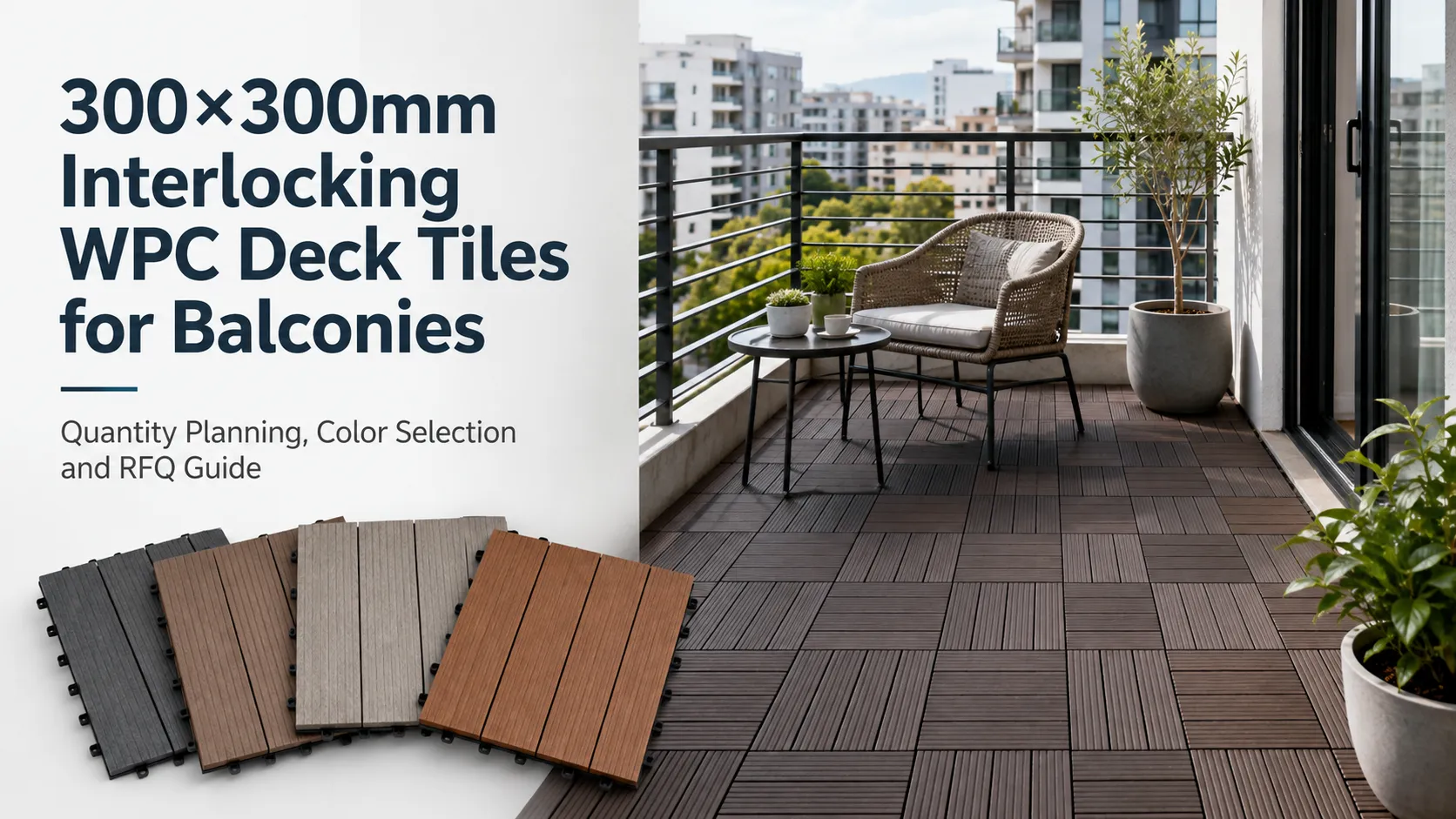
Ordering interlocking WPC deck tiles for a balcony requires more than measuring floor area. Buyers must confirm the surface, drainage, door clearance, obstacles, dimensions, color, carton quantity, and replacement plan.
Latitude Interiors lists a WPC DIY tile in a 23×300×300mm format, with eight basic color options and customized colors for balcony, garden, and terrace applications. This guide explains how B2B buyers can assess suitability, calculate quantity, prevent specification errors, and prepare a clearer RFQ.
Are 300×300mm Interlocking WPC Deck Tiles Suitable for Your Balcony?
A correct tile count is useless if the finished surface obstructs a door, covers a drain, or rocks on an uneven base. Review site conditions before finalizing quantity.
Check the Surface, Slope, Drainage, and Door Clearance
Interlocking deck tiles are generally considered for stable, hard surfaces where the bases can sit evenly and connect without excessive movement. Concrete or hard paving may be suitable, but loose sections, sharp height changes, standing water, or an unstable substrate should be addressed first.
Measure the clearance beneath balcony doors and compare it with the finished floor height. The Latitude Interiors tile is listed at 23mm, but buyers should confirm whether this is the complete tile height and whether the installation requires any additional layer. A door that clears the existing surface may not clear the completed tile system.
Mark every drain, threshold, low point, and outlet on the site drawing. Preserve inspection access and the drainage route. Deck tiles should not be treated as a remedy for an underlying slope or drainage problem.
Identify Obstacles That Affect Layout and Quantity
Columns, railing posts, drains, pipe penetrations, angled walls, and narrow perimeter strips can increase cutting and reduce reusable offcuts. Prepare a dimensioned drawing or photograph showing overall dimensions, doors, drains, obstacles, tile direction, and required access.
Buyers should also ask whether the tile can be cut, where cuts are permitted, and whether cutting affects the locking base. These details are not published for the referenced product and should be verified against its specification. Identical balconies may share one layout; different layouts should be calculated separately.
What Does the 300×300×23mm Deck Tile Size Mean?
For this WPC DIY tile, 300×300mm describes the listed plan dimensions, while 23mm is the published height or thickness. All three dimensions should appear on the RFQ and purchase order.
300×300mm vs. 12×12 Inches
Searches often use “12×12 deck tiles,” but 300mm is approximately 11.81 inches, not exactly 12 inches. The difference can affect layouts, cuts, replacements, and mixed stock.
Similar face dimensions do not prove compatibility; locking tabs, base grids, or edge directions may differ. Use the same product code for initial and replacement orders, and physically verify compatibility before mixing tiles from different sources.
A purchase order should state the product model, dimensions in millimeters, total height, color or sample reference, locking orientation when relevant, and quantity in both tiles and cartons.
Calculate Coverage Before Converting Tiles Into Cartons
A 300×300mm tile has a theoretical face area of 0.09m². One square meter therefore requires approximately 11.11 tiles. Round the result up because tiles are purchased as whole pieces.
The order may need to be rounded again to match the carton quantity. Latitude Interiors does not publish tiles per carton or carton coverage on the product page, so both figures should be requested before approving a quotation.
How Many WPC Deck Tiles Do You Need for a Balcony?
Quantity planning should move through three stages: measured area, theoretical tile count, and full-carton order quantity. Cutting and replacement stock should be added only after reviewing the layout.
Calculate Tiles for Rectangular Balconies
Measure the usable length and width in meters, multiply them to find the area, divide by 0.09m², and round up to the next whole tile.
| Balcony area | Calculation | Theoretical minimum |
|---|---|---|
| 2m² | 2 ÷ 0.09 | 23 tiles |
| 5m² | 5 ÷ 0.09 | 56 tiles |
| 10m² | 10 ÷ 0.09 | 112 tiles |
These are minimums before cuts, carton rounding, and replacement stock. For apartment, hotel, or property programs, calculate each layout type first. Identical units can then be multiplied, while unusual balconies remain separate line items.
Require each quotation to state tiles per carton, square meters per carton, carton weight, and partial-carton availability.
Adjust for Irregular Layouts, Drains, and Cut Pieces
Divide an L-shaped balcony into smaller rectangles and combine the results. Do not automatically deduct the full area of a drain, column, or small opening; cutting around it may still consume most of a tile.
A fixed five- or ten-percent allowance is not appropriate for every project. The correct allowance depends on perimeter complexity, tile direction, unusable offcuts, installation damage risk, carton size, and future replacement needs. The installer or project manager should approve the final allowance after reviewing the layout.
For larger orders, retain the color code, sample reference, production identification, and replacement tiles together. A later order may use the same color name but show a visible variation.
How to Select WPC Deck Tile Colors
Latitude Interiors publishes eight basic color options and a customized-color option for the 23×300×300mm tile. The full color codes, custom-color minimum, and sample schedule are not publicly listed and should be confirmed per inquiry.
Compare Standard Colors, Custom Colors, and Physical Samples
Standard colors may suit distributor inventory, small projects, and repeat-order programs. Customized colors may suit branded developments but can add sample, quantity, and production requirements.
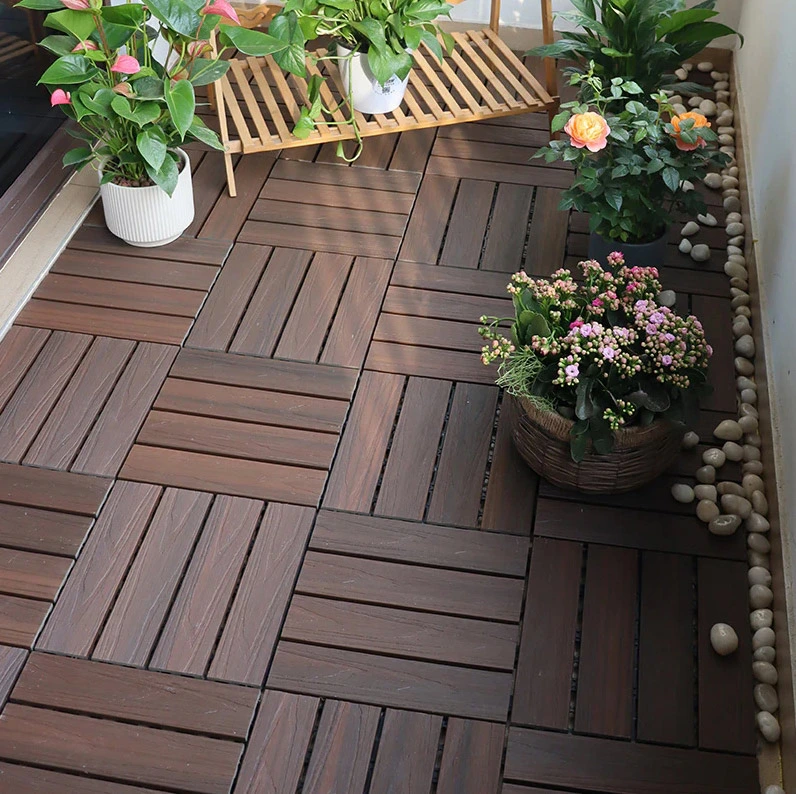
Do not approve a color from a screen image alone. Review a physical sample in daylight, shade, and the lighting visible from adjacent interiors. Compare it with railings, walls, and other fixed finishes. Record the sample code, surface appearance, dimensions, and approval date.
For customized colors, confirm the reference standard, acceptable variation, sample process, minimum order requirement, and how the approved sample will be identified during production.
Common WPC Deck Tile Ordering Mistakes
Frequent errors include treating 300mm as exactly 12 inches, calculating without carton data, ignoring threshold height, deducting drains without cuts, assuming lock compatibility, selecting color from photos, and applying a waste percentage without a layout.
These errors can cause shortages, excess stock, incompatible replacements, delays, or incomparable quotations. Use a measured plan, an approved sample, precise product codes, and one written specification shared by the purchaser, supplier, warehouse, and installer.
WPC Deck Tile RFQ Checklist for B2B Buyers
A useful RFQ should include:
- Product: interlocking WPC deck tile
- Required size: 23×300×300mm
- Required color or sample reference
- Standard or customized color
- Balcony dimensions and total area
- Estimated tile quantity
- Number of locations or layout types
- Destination country or port
- Sample requirement
- Packaging or private-label request
- Required product documents
- Target purchasing schedule
The 23×300×300mm interlocking WPC deck tiles page provides the confirmed size, color options, application references, and an inquiry route.
What to Confirm Before Comparing Suppliers
Quotations are comparable only when they cover the same specification. Ask each supplier to confirm tiles and coverage per carton, tile and carton weight, exact color code, locking-base structure, cutting restrictions, available edge pieces, substrate requirements, MOQ, production schedule, packaging, pallet information, relevant product-level documents, and replacement-order policy.
Latitude Interiors presents WPC tiles within a broader range of WPC and SPC products. The product page also describes sample access, design support, quality inspection, transportation coordination, and after-sales communication. Buyers can review Latitude Interiors for the wider range and learn more about Latitude Interiors for company information. The decision should rest on the written specification, approved sample, terms, and product-specific documents.
Conclusion
A 300×300mm balcony deck tile order should begin with site suitability, not a product photograph. Check the surface, drainage, obstacles, and 23mm height; calculate the theoretical requirement from 0.09m² per tile; then adjust for layout, full cartons, and replacement stock. Confirm color with a physical sample and use the same specification across the RFQ, quotation, purchase order, and installation documents.
Project buyers can request a WPC deck tile sample and quantity review by submitting balcony dimensions, layout or site photographs, required color, estimated area, destination, and packaging needs.
Frequently Asked Questions
How many 300×300mm deck tiles are needed per square meter?
One tile theoretically covers 0.09m², so one square meter requires about 11.11 tiles. Round up to whole tiles, then to full cartons. Cuts, obstacles, and replacement stock may increase the final quantity.
Are 300×300mm deck tiles the same as 12×12-inch tiles?
No. A 300mm side is approximately 11.81 inches. Products may also use different locking bases, so dimensions and physical compatibility should be checked before mixing stock or ordering replacements.
Can interlocking WPC deck tiles be installed over concrete?
A stable, hard concrete surface may be suitable, but flatness, slope, drainage, cracks, standing water, and door clearance must be checked. The final decision should follow the product-specific installation requirements.
How do I calculate deck tiles for an irregular balcony?
Divide the balcony into measurable rectangles, calculate each area, and add the results. Mark angled edges, drains, columns, and narrow strips separately so the installer can determine reusable offcuts and the appropriate allowance.
Can WPC deck tile colors be customized?
The referenced Latitude Interiors product lists eight basic options and customized colors. Color reference, sample approval, variation, minimum order requirement, and production schedule should be confirmed for the project.