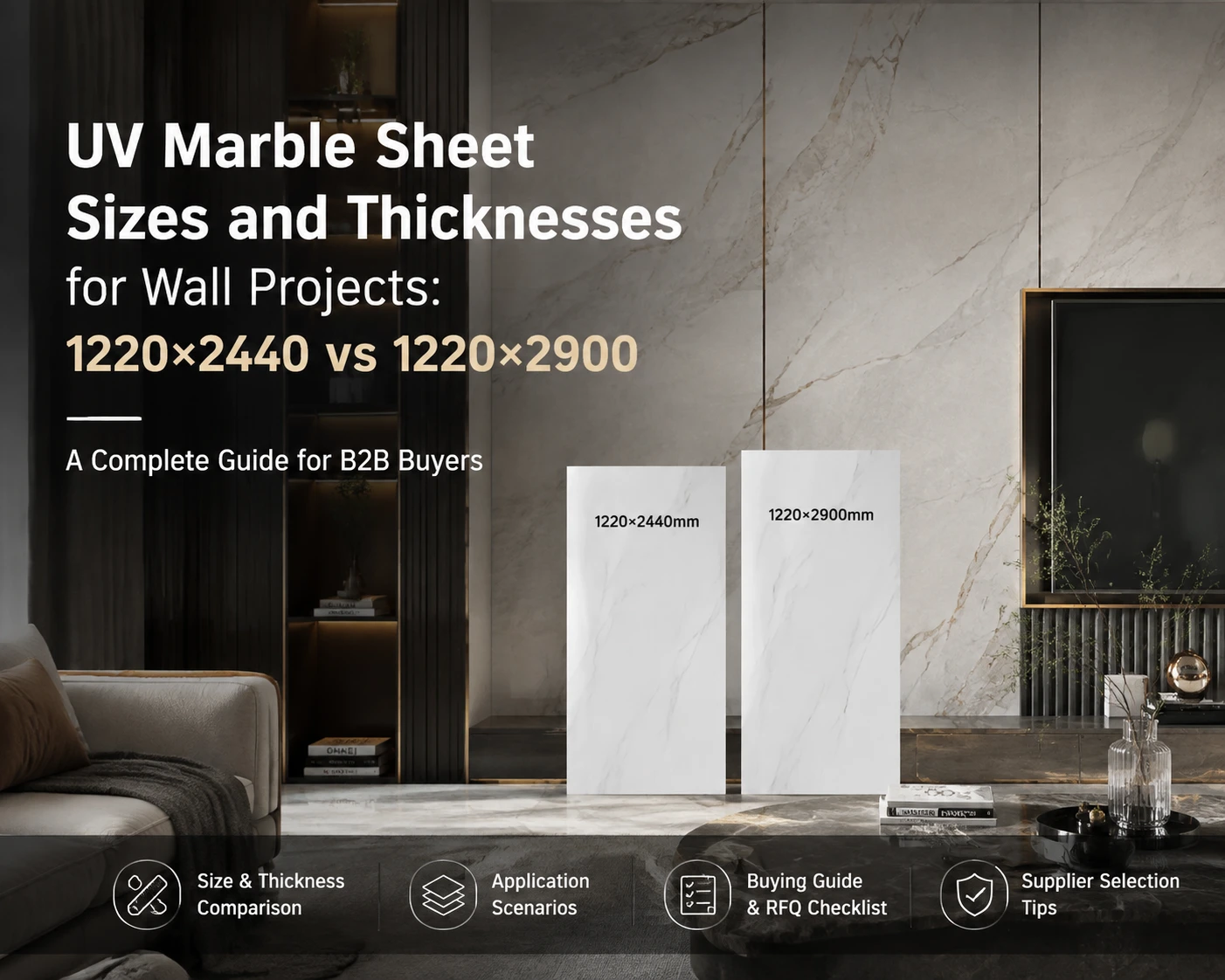
Selecting the correct UV marble sheet sizes and thicknesses is not simply a matter of choosing the largest available panel. Commercial buyers must match the sheet dimensions to wall height, panel layout, site access, cutting requirements, installation conditions, and the supplier’s available specification combinations.
For hotel, office, residential, and public-space projects, an unsuitable size may create unnecessary joints or material waste. An unsuitable thickness may conflict with the intended substrate or installation method. Before requesting a quotation, buyers should therefore confirm the wall measurements, required panel thickness, surface design, order quantity, and project conditions.
This guide explains how to compare 1220×2440mm and 1220×2900mm UV marble sheets, review available thicknesses from 2mm to 4mm, estimate project quantities, and prepare a more accurate request for quotation.
UV Marble Sheet Standard Sizes and Thickness Options
UV marble sheet dimensions are normally expressed as width × length × thickness. Each value affects a different part of the project. Width and length determine coverage, panel layout, joints, cutting, and handling. Thickness affects product specification, rigidity, installation planning, and compatibility with the intended wall system.
Latitude Interiors lists UV marble sheets made from PVC and calcium powder in two optional sizes: 1220×2440mm and 1220×2900mm. Published thickness options include 2, 2.2, 2.3, 2.4, 2.5, 2.6, 2.8, 3, and 4mm. Surface choices include marble grain, wood grain, 3D designs, and customized colors.
Common UV Marble Sheet Dimensions for Wall Applications
The 1220×2440mm UV marble sheet is approximately equivalent to a nominal 4×8-foot panel. It is a useful reference size for buyers who receive architectural dimensions in millimeters but purchasing requests in feet and inches. Because 1220×2440mm is only an approximate metric equivalent of 4×8 feet, the final purchase order should always state the required dimensions in millimeters.
The 1220×2900mm panel has the same published width but provides additional length. It may be considered when the project has taller wall sections or when the proposed layout could benefit from longer vertical coverage. However, a longer sheet is not automatically the better option. The buyer must also consider freight packaging, unloading space, elevators, stairways, doors, cutting equipment, and the installer’s handling plan.
Before deciding which standard UV marble sheet size to order, confirm:
- Finished wall height and width
- Panel orientation
- Door, window, column, and service openings
- Joint position and trim requirements
- Site access and maximum manageable panel length
- Whether all required thicknesses are available in the selected size
The published sizes and thicknesses can be reviewed on the UV marble sheets in 1220×2440mm and 1220×2900mm sizes product page.
Available Thickness Options and How Buyers Should Compare Them
A common purchasing question is, “What thickness is a UV marble sheet?” There is no single universal answer because suppliers may manufacture different product constructions and specification ranges. For the product covered here, the published choices extend from 2mm to 4mm, with several intermediate options.
Buyers should not select thickness solely by comparing price per sheet. The appropriate specification may depend on the wall substrate, installation method, panel dimensions, handling conditions, edge details, and project requirements. A thickness that works for one installation system should not automatically be specified for another.
When comparing a 2mm, 3mm, or 4mm UV marble sheet, ask the supplier to confirm:
- Actual nominal thickness and permitted tolerance
- Availability in the required sheet size
- Recommended substrate and installation system
- Whether the sample matches the production specification
- Packaging method for the selected dimensions
- Any applicable product data or test documents
Latitude Interiors publishes the available thickness range but does not publicly assign each thickness to a specific building type. The final selection should therefore be verified against the project specification and installation conditions rather than based on a general rule.
How to Choose Between 1220×2440mm and 1220×2900mm UV Marble Sheets
The main difference between these two UV marble panel dimensions is length. The correct choice depends on how each panel fits the actual wall layout, not simply on which sheet covers more area.
| Decision factor | 1220×2440mm | 1220×2900mm |
|---|---|---|
| Approximate format | Nominal 4×8-foot size | Longer metric panel |
| Primary consideration | Compatibility with common layouts and handling conditions | Additional vertical coverage |
| Confirm before ordering | Wall dimensions, cutting plan, joints and quantity | Wall height, access, handling, packaging and thickness availability |
| Main procurement risk | Excess cutting if the layout is not planned | Ordering panels that are difficult to transport or handle on site |
Match Sheet Size With Wall Dimensions and Project Layout
Begin with a measured wall elevation rather than a rough area estimate. Record the finished height and width of every wall section, then mark doors, windows, columns, corners, electrical points, and other openings. This information helps determine whether the panels should run vertically or horizontally and where visible joints may appear.
A 1220×2900mm UV marble sheet may suit a taller wall layout, but only when the longer dimension aligns with the design and can be moved safely through the building. A 1220×2440mm sheet may be easier to incorporate into some layouts, but additional joints or cuts may be required depending on the finished wall height.
The next step is to prepare a simple panel layout showing:
- Panel direction
- Starting position
- Planned joints
- Cut pieces
- Reusable offcuts
- Openings and corner details
This process gives contractors and buyers a practical basis for choosing between the two sizes. It also provides the supplier with enough information to check whether the requested dimensions, thickness, and finish can be supplied as specified.
Reduce Material Waste and Ordering Risk Before Production
Purchasing by total square meters alone can produce inaccurate quantities. Two projects with the same wall area may need different numbers of panels because their wall proportions, openings, pattern direction, and cutting plans differ.
To estimate how many UV marble sheets are needed, first calculate the gross wall area. Then compare each wall section with the usable area of the selected panel. Doors and windows should be recorded, but they should not always be deducted immediately: material around openings may require several separate cuts, and some offcuts may not be reusable.
Avoid applying a fixed waste percentage without reviewing the project layout. The appropriate allowance depends on:
- Number and shape of openings
- Panel orientation
- Pattern or grain direction
- Corner and edge treatment
- Required visual alignment
- Risk of damage during handling
- Availability of replacement panels from the same production order
For large commercial projects, a room-by-room or elevation-by-elevation quantity schedule is more reliable than one total area figure. It also helps prevent shortages caused by assuming every offcut can be reused.
How Thickness Affects UV Marble Sheet Selection
Thickness is a procurement specification, not a standalone measure of suitability. A thicker panel should not automatically be described as better, and a thinner panel should not automatically be treated as a budget-only option. The complete wall assembly must be considered.
Questions to Ask Before Selecting Panel Thickness
The first question is not “Which thickness is most popular?” It is “What conditions must this panel work with?”
Before choosing a PVC marble panel thickness, identify the substrate, installation method, sheet size, edge treatment, and expected handling conditions. The installer may also need to confirm whether the wall is flat enough for the proposed system and whether additional preparation is required.
A useful pre-order review should address:
- Is the wall substrate flat, stable, clean, and suitable for the installation system?
- Will panels be installed as full sheets or cut into smaller sections?
- Are trims, corners, joints, or other accessories part of the design?
- Does the supplier recommend a particular thickness for the proposed configuration?
- Are size and thickness tolerances included in the specification?
- Can a production-representative sample be evaluated before the bulk order?
These questions matter because the correct thickness depends on the complete application. Where the supplier has not published an application-specific recommendation, the buyer should request written confirmation rather than relying on an assumption from another product or manufacturer.
Common Risks of Ordering the Wrong Thickness
An incorrect thickness can affect more than the material cost. It may create a mismatch with trims, joint details, cutting methods, packaging plans, or the intended installation system. Problems may not become visible until the material reaches the site.
Common procurement risks include:
- Ordering a thickness that is unavailable in the required sheet length
- Assuming all listed sizes and thicknesses can be combined
- Approving a sample without recording its exact specification
- Using a quotation that does not state thickness tolerance
- Changing thickness after accessory or installation decisions have been made
- Mixing panels from separate orders without confirming finish consistency
These risks can be reduced by using one approved specification sheet across the supplier, purchaser, contractor, and site team. The purchase order should repeat the agreed dimensions, thickness, surface code, quantity, packaging requirements, and sample reference.
UV Marble Sheet Specification Checklist for RFQs
A clear RFQ allows suppliers to quote the same requirement and helps buyers compare offers on more than price. An inquiry that only says “4×8 UV marble sheet” leaves several important decisions unresolved.
Include the following information:
- Required size in millimeters
- Required nominal thickness
- Total quantity in sheets or square meters
- Marble grain, wood grain, 3D design, or custom-color requirement
- Project type and interior application
- Panel orientation or layout drawing, when available
- Destination country or port
- Sample requirement
- Required packaging information
- Requested product documents
- Target order and delivery schedule
Ask the manufacturer to state which details are confirmed and which remain subject to production review. MOQ, lead time, packaging quantity, custom dimensions, tolerances, and available size-thickness combinations may vary and should be confirmed for the individual order.
Applications, Surface Selection, and Sample Approval
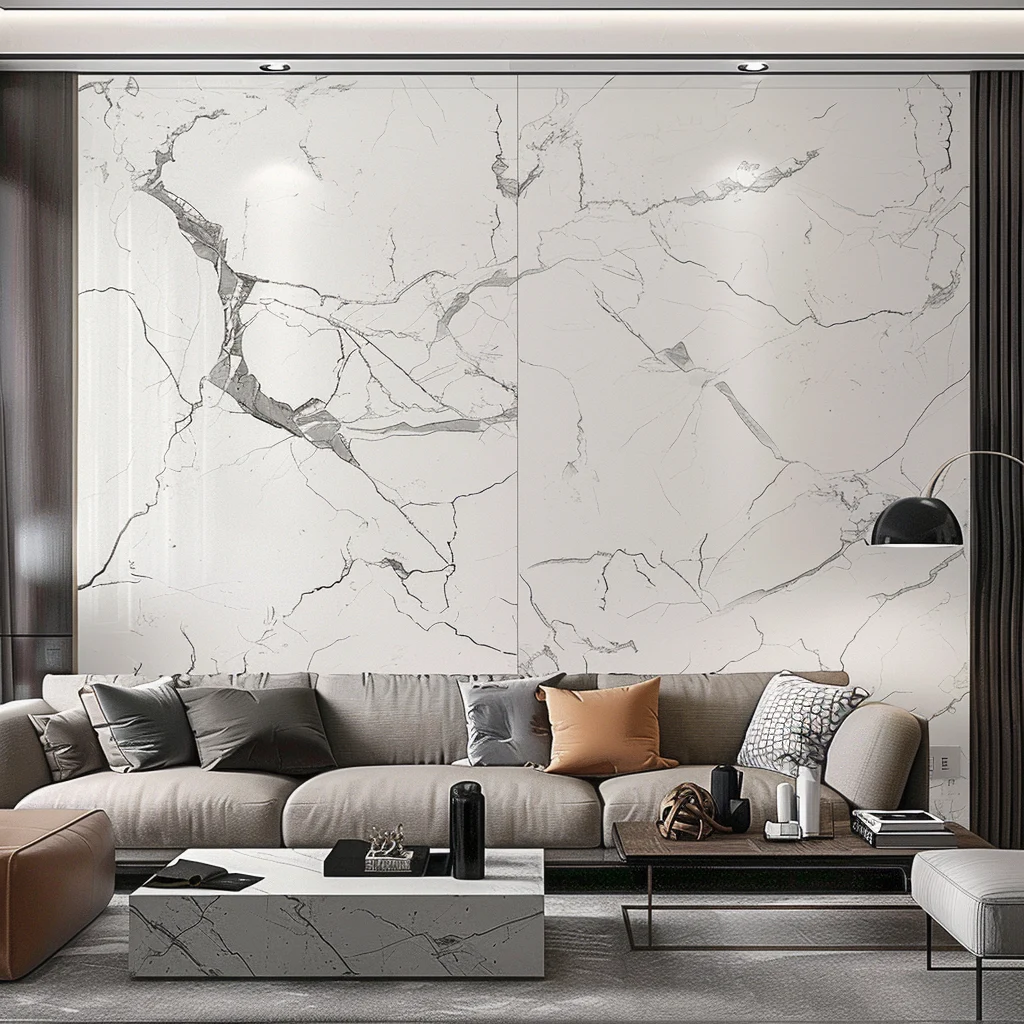
Published applications for these UV marble sheets include hotels, residential interiors, office buildings, public places, and stadiums. Available surfaces include marble grain, wood grain, 3D designs, and customized colors.
The application determines what the sample review should focus on. A hotel buyer may need to examine consistency across multiple rooms. An office project may prioritize coordination with flooring and furniture. A distributor may need designs that fit several local customer segments.
Digital images are useful for initial selection but should not replace physical sample approval. Surface color, gloss, pattern scale, and visual effect may appear different under project lighting. Record the approved sample code, size, thickness, and surface description so the production order can be checked against the same reference.
Choosing a UV Marble Sheet Supplier
A suitable supplier should do more than provide a unit price. Buyers need clear specifications, sample support, customization communication, quality checks, packaging coordination, and a defined contact process.
Latitude Interiors focuses on wall panels, flooring, and interior decoration products and publishes OEM/ODM support for project-specific designs, materials, sizes, finishes, and related requirements. Its brand information also describes raw-material, in-production, and final-product inspection stages.
Buyers can use Latitude Interiors to review the broader product and service range, while learning more about Latitude Interiors provides additional company background. For a UV marble sheet project, the supplier evaluation should still be based on the exact written specification, approved sample, applicable documentation, order terms, and packaging details rather than general company claims.
Conclusion
The correct UV marble sheet size and thickness should be selected from the actual wall layout and installation requirements. A 1220×2440mm panel offers a nominal 4×8-foot format, while a 1220×2900mm panel provides additional length. Neither option is universally preferable.
Before ordering, confirm the wall dimensions, panel orientation, openings, required thickness, surface design, quantity, sample reference, packaging needs, and available size-thickness combinations. This prevents specification gaps and gives the supplier enough information to prepare a relevant quotation.
Project buyers can request a UV marble sheet sample and specification confirmation by submitting the required size, thickness, finish, application, target quantity, destination, and available drawings.
FAQs
What is the standard size of a UV marble sheet?
Latitude Interiors publishes two optional sizes for the referenced UV marble sheet: 1220×2440mm and 1220×2900mm. Availability should be confirmed together with the required thickness and surface design.
Is a 1220×2440mm UV marble sheet the same as a 4×8 sheet?
It is approximately equivalent to a nominal 4×8-foot sheet. Because the dimensions are not mathematically identical, B2B purchase orders should state the required size in millimeters to avoid confusion.
What UV marble sheet thicknesses are available?
The published thickness options are 2, 2.2, 2.3, 2.4, 2.5, 2.6, 2.8, 3, and 4mm. The appropriate option depends on the size, substrate, installation system, and project specification.
How do I know which UV marble sheet size is right for my project?
Compare each available panel size with the finished wall height, width, openings, planned orientation, joint positions, site access, and cutting plan. Prepare a panel layout before confirming the order quantity.
Can custom UV marble sheet colors or designs be requested?
The product information lists marble grain, wood grain, 3D designs, and customized colors. Buyers should submit the desired design reference and approve a physical sample before bulk production.