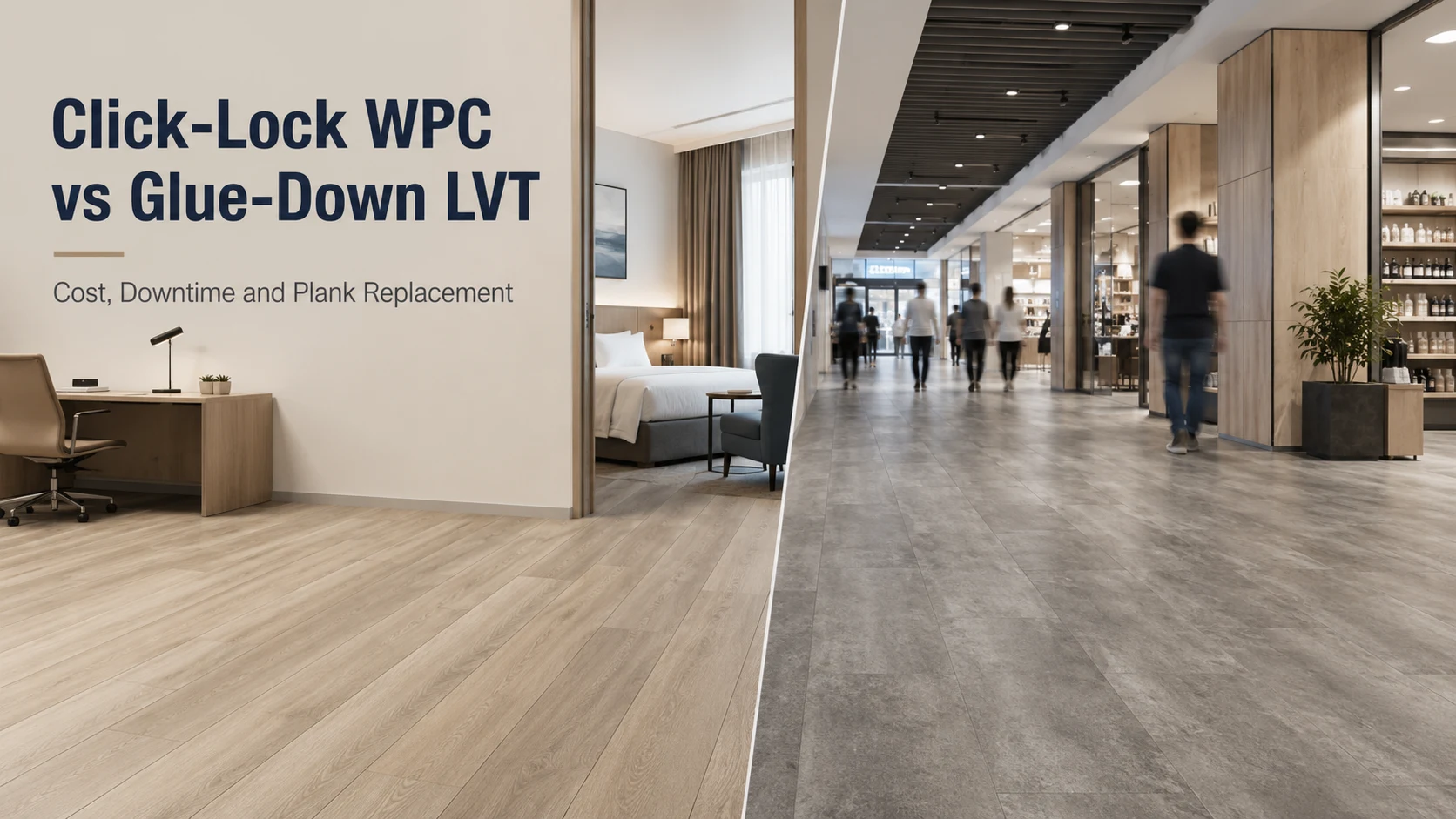
Choosing between click-lock WPC and glue-down LVT is not simply a material-price decision. For a commercial project, the stronger option depends on subfloor condition, installation access, traffic type, rolling loads, reopening deadlines, and future plank replacement. Click-lock WPC often suits phased renovations where speed matters. Glue-down LVT is commonly considered for large open areas, sustained traffic, rolling equipment, and localized repairs. Every recommendation should be checked against the exact product, adhesive, substrate, and warranty conditions.
Click-Lock WPC or Glue-Down LVT: Which One Fits the Project?
| Decision factor | Click-lock WPC | Glue-down LVT |
|---|---|---|
| Main advantage | Faster floating installation | Stable direct bond |
| Typical use | Phased renovation, enclosed rooms | Large or heavily used areas |
| Reopening | No full-spread adhesive waiting time | Timing depends on the adhesive |
| Rolling loads | Requires SKU-level approval | Commonly considered for rolling traffic |
| Local replacement | Depends on plank location | Individual planks can often be replaced |
| Main risk | Joint stress or restricted movement | Moisture, contamination, or poor bond |
Commercial flooring guidance commonly positions glue-down LVT for large open spaces, heavy traffic, and rolling loads, while rigid click systems support quicker adhesive-free installation. SKU-level review still controls.
Choose Click-Lock WPC When Speed and Limited Disruption Matter
Click-lock WPC can fit hotel rooms, enclosed offices, leased interiors, and phased refurbishment. It is less suitable when fixed installations restrict movement, long runs exceed installation limits, or rolling loads stress the joints.
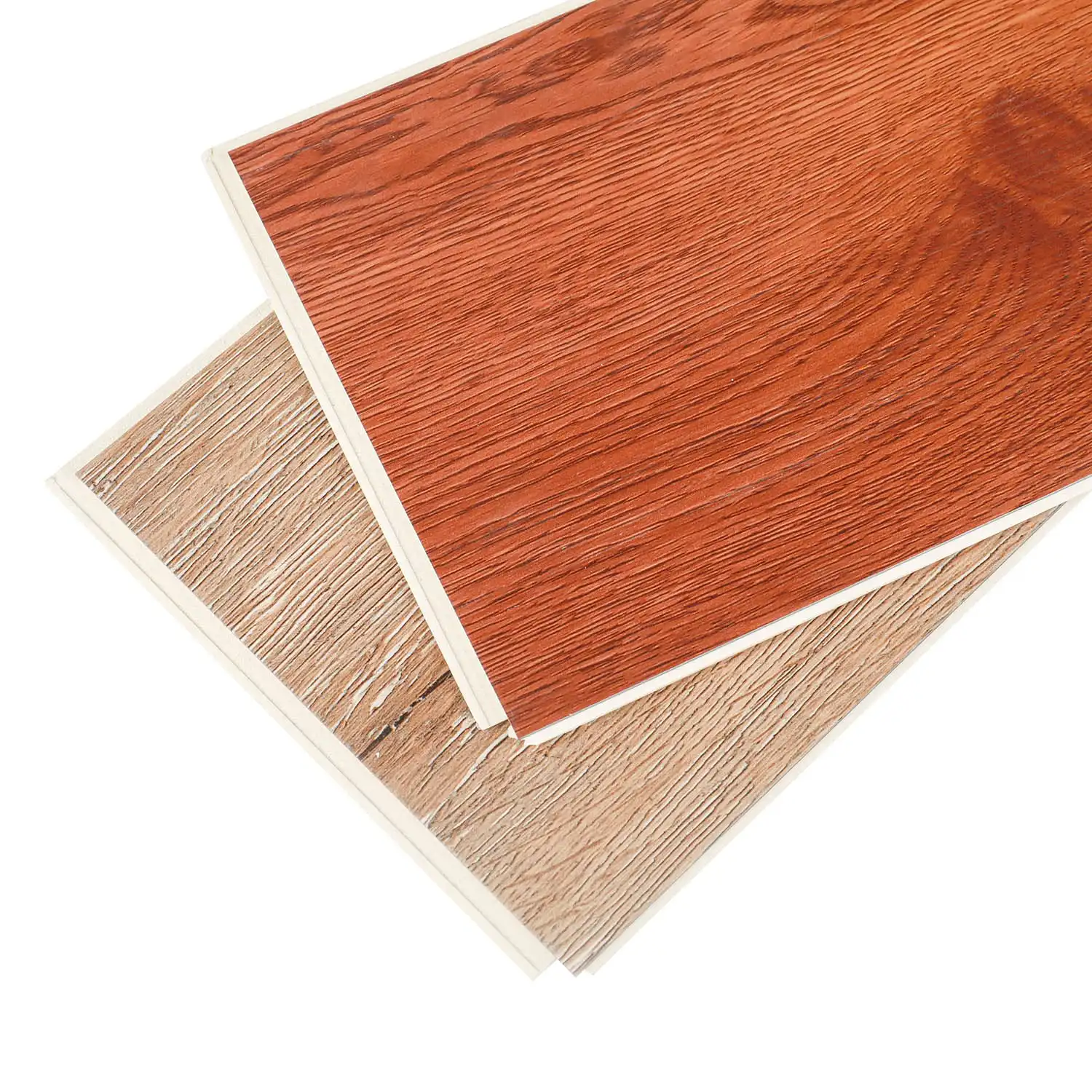
Before purchasing, confirm the locking profile, maximum continuous installation area, expansion requirements, transition locations, backing configuration, and commercial-use limits. A fast installation will not correct an uneven or unstable substrate.
Choose Glue-Down LVT When Stability and Spot Repair Matter
Glue-down LVT is often considered for retail aisles, corridors, busy offices, and areas exposed to carts. Direct bonding supports stability and localized repair.
It is a poor fit when substrate moisture is unknown, preparation is incomplete, or the schedule ignores adhesive requirements. Procurement documents should identify the approved adhesive, substrate type, moisture-testing responsibility, rolling procedure, and restrictions for traffic and furniture.
What Causes the Cost and Performance Differences?
Floating Movement and Joint Stress in Click-Lock WPC
A floating floor transfers movement through connected planks. Low spots can let boards deflect under traffic, while restricted perimeter movement can concentrate stress at joints. Long runs, unsuitable soft underlayment, fixed millwork, and caster traffic may increase the risk of gapping, damaged locks, or lifting.
The useful question is not only “Is click-lock WPC suitable for commercial use?” It is whether the selected construction suits the room geometry and load path. Review the layout, mark fixed objects and transitions, verify subfloor tolerances, and confirm the intended application in the warranty.
Adhesive Bond and Subfloor Conditions in Glue-Down LVT
Glue-down performance depends on the plank, adhesive, substrate, moisture, surface preparation, and site environment. Dust, residue, excess moisture, incorrect flash time, weak adhesive transfer, or premature traffic can reduce bond strength. Heavy rolling loads and temperature changes can also contribute to gapping when the adhesive system is unsuitable.
Treat the flooring and adhesive as one system. Confirm who accepts the substrate, records moisture tests, specifies the adhesive, and carries responsibility if bond failure occurs.
Total Installed Cost and Commercial Flooring Downtime
Compare Total Installed Cost, Not Unit Price Alone
A comparable quotation should separate flooring, waste allowance, accessories, underlayment or adhesive, substrate repair, removal, labor, transitions, protection, and freight. Glue-down LVT may require more substrate finishing and adhesive labor. Click-lock WPC may require extra transitions or flatness correction.
A lower material price may be offset by a longer closure, furniture moves, or access restrictions. Ask each bidder to state inclusions, exclusions, substrate assumptions, installation sequence, and the point at which the area can return to normal service.
Calculate Downtime Through Full Reopening
Measure installation speed from substrate inspection to unrestricted use, not from the first installed plank. The schedule may include demolition, patching, moisture work, installation, rolling, cleaning, furniture replacement, and waiting periods.
Click-lock WPC may be faster when the substrate is ready and the layout is uncomplicated. Glue-down LVT may still be the better decision when stability and localized repair outweigh a shorter initial closure. Confirm separate limits for foot traffic, furniture, wet cleaning, and rolling equipment.
Commercial Traffic, Failure Risk and Plank Replacement
Match the Installation System to the Actual Loads
Office chairs, service carts, luggage trolleys, cleaning machines, and hospital equipment do not impose identical forces. Fixed shelving can also restrict a floating floor or create concentrated pressure.
Ask the supplier to review wheel type, approximate equipment weight, travel frequency, turning zones, and fixed installations. Do not assume every click-lock WPC product can handle commercial rolling loads, or that every glue-down LVT and adhesive combination is approved for the same duty.
Compare Replacement by Damage Location and Root Cause
A click-lock plank near a wall may be reached by removing adjacent rows. A damaged plank in the center of a furnished room can require a larger dismantling area unless the product has an approved cut-in repair method. Glue-down LVT can often be replaced one plank at a time, but the old material and adhesive must be removed and the substrate restored.
Diagnose the cause before replacement. Joint separation may indicate flatness, restricted movement, underlayment, or load issues. A loose glue-down plank may point to moisture, contamination, adhesive selection, or installation timing. Spare stock should account for waste, batch consistency, vulnerable zones, and the expected service period.
Match the System to the Commercial Application
Guest rooms and enclosed offices may prioritize phased installation and rapid turnover. Retail aisles, entrances, and corridors may place more value on rolling-load performance, dimensional control, and spot repair.
A mixed-zone specification can be practical: click-lock WPC may be evaluated for enclosed, lower-disruption areas, while glue-down LVT may be evaluated for circulation paths or moving loads. Coordinate finished floor heights, transitions, visual matching, cleaning methods, and spare stock.
Latitude Interiors lists multiple commercial WPC flooring options with customizable colors, sizes, thickness ranges, wear-layer choices, click systems, textures, and backing configurations. Final suitability should be checked against traffic, substrate, room dimensions, and installation conditions.
RFQ Checklist and Commercial Flooring Supplier Selection
Send an RFQ That Produces Comparable Quotations
Include the project country, total area, zone schedule, drawings, substrate, traffic pattern, rolling equipment, fixed furniture, installation window, reopening date, preferred visual, estimated quantity, and sample requirements.
Request the exact construction, dimensions, thickness, wear layer, locking or bonding method, backing, finish, packing data, waste recommendation, installation instructions, and commercial-use limits. State whether adhesive, transitions, spare stock, freight, or installation are included.
Verify Documentation, Samples, and Replacement Support
Technical data should match the quoted thickness, wear layer, backing, and installation construction. Ask for installation instructions, warranty conditions, and project-required test documents. A mock-up can help assess appearance, transitions, joint behavior, or cleaning procedures.
Supplier evaluation should also cover sample response, batch consistency, packaging, replacement material, discontinuation communication, and claim handling. Latitude Interiors specializes in WPC and SPC flooring and interior materials, while about Latitude Interiors provides company background for procurement review. Project suitability should still be confirmed in writing before ordering.
Conclusion
Click-lock WPC deserves consideration when installation speed, phased access, and reduced adhesive-related downtime are primary concerns. Glue-down LVT is often more suitable when the project involves large open areas, rolling loads, dimensional control, or frequent localized replacement. The correct choice comes from comparing the complete system: substrate, layout, loads, adhesive or locking construction, reopening schedule, maintenance plan, and spare-stock needs.
For a project-specific review, submit application zones, drawings, substrate details, traffic and rolling-load information, target date, required dimensions or material configuration, sample needs, and estimated quantity through request a commercial flooring recommendation. Latitude Interiors can review available WPC configurations against the stated conditions.
Frequently Asked Questions
Is click-lock WPC suitable for commercial use?
It may be suitable when the exact product is approved for the expected traffic, room size, load type, and layout. Confirm maximum floor area, transitions, fixed furniture, and rolling-load conditions.
Is glue-down LVT better for high-traffic areas?
It is commonly considered for heavy traffic, large areas, and rolling loads, but performance still depends on the LVT, adhesive, substrate preparation, moisture, and installation quality.
Which flooring is faster to install: click-lock or glue-down?
Click-lock WPC often avoids full-spread adhesive and associated waiting periods. Glue-down scheduling must include substrate work, adhesive application, rolling, and reopening restrictions.
Can glue-down LVT planks be replaced individually?
Often, yes. The damaged plank and old adhesive must be removed, the substrate restored, and the replacement bonded with a compatible adhesive.
How much spare commercial flooring should be ordered?
The amount depends on layout waste, project size, batch continuity, vulnerable areas, expected repair frequency, and future product availability.