
Understanding how to match WPC wall panels with flooring is a practical requirement in commercial interior projects, not simply a matter of choosing two attractive finishes. Walls and floors form the largest continuous visual surfaces in offices, hotels, restaurants, retail stores, and reception areas. When the undertones, grain direction, gloss, or material scale conflict, the finished space can look fragmented even when each product appears suitable on its own.
For designers, contractors, distributors, and procurement teams, the wall-and-floor package must also satisfy cleaning, durability, installation, budget, and batch-control requirements. Latitude Interiors Limited supplies WPC wall panels together with WPC and SPC flooring options, allowing commercial buyers to coordinate finishes and technical specifications within one project discussion.
Should WPC Wall Panels Match the Flooring Exactly?
WPC wall panels do not need to reproduce the flooring color or grain exactly. In most commercial interiors, a slight difference in lightness, pattern, or texture creates a more controlled result than using nearly identical wood finishes on every surface.
Exact matching often causes problems during material approval. Two products sold under the same color name may have different yellow, red, or gray undertones. Even when the initial samples appear close, variations in film printing, surface texture, production batch, and lighting angle can make the completed wall and floor look unintentionally mismatched.
A more dependable approach is to select one dominant surface. A fluted feature wall may carry the stronger grain and shadow lines, while the flooring remains visually quieter. Where the commercial flooring already has a pronounced wood pattern, a restrained wall panel usually gives furniture, signage, and lighting more space to work.
Begin with Undertones Rather Than Color Names
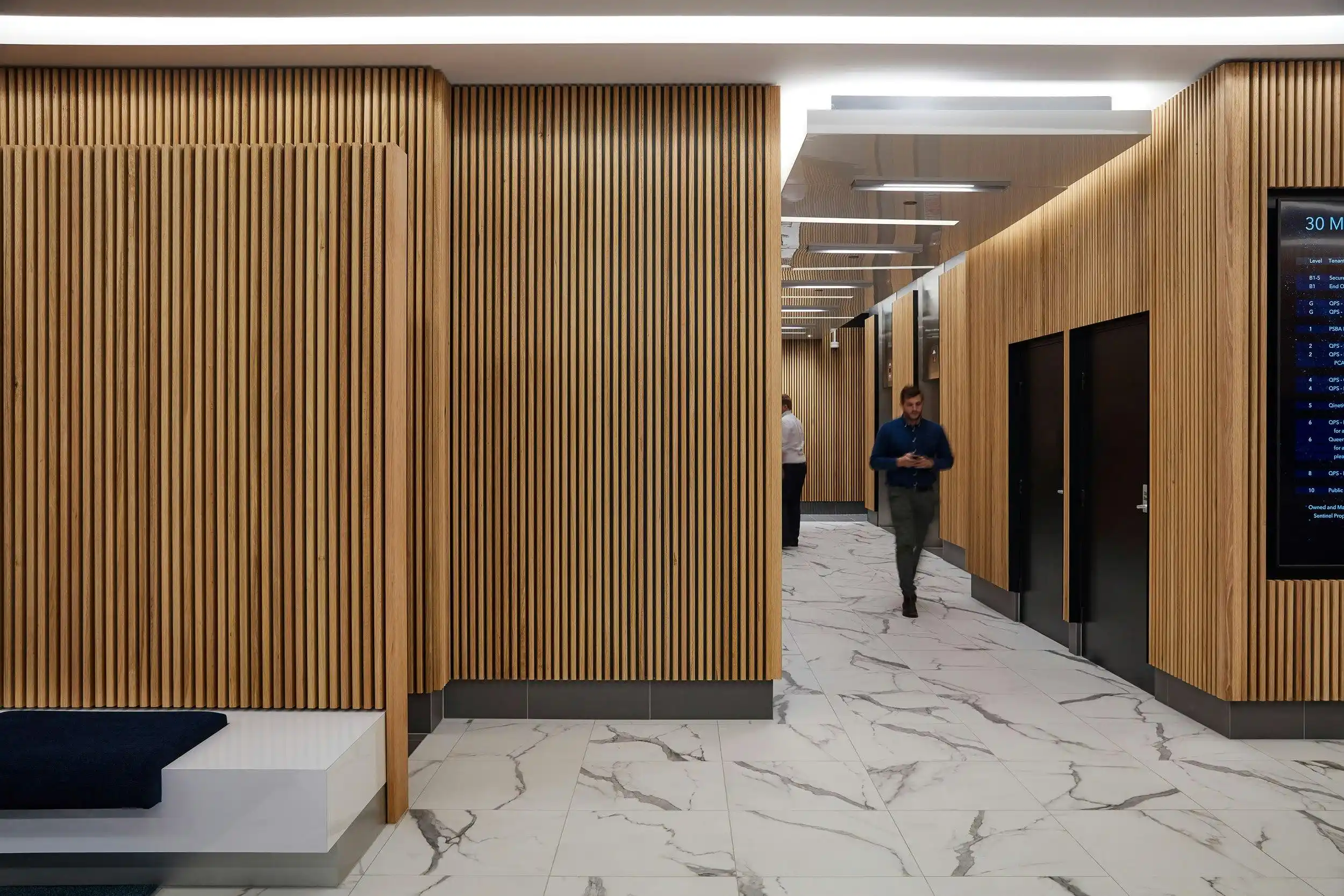
Commercial wall and floor color combinations should be assessed by undertone before color name. Terms such as oak, walnut, beige, and gray are too broad to guide a large project order.
Warm oak flooring often works with honey, beige, warm gray, or medium walnut wall panels. Cool gray flooring is more compatible with ash, charcoal, or neutral gray finishes. Dark brown floors usually need lighter wall surfaces to prevent reception areas and corridors from feeling compressed.
| Flooring direction | Suitable WPC wall panel direction |
|---|---|
| Light warm oak | Medium walnut, beige, or warm-gray panel |
| Cool gray flooring | Ash, charcoal, or neutral-gray panel |
| Dark brown flooring | Pale oak, cream, or light stone effect |
| Neutral commercial floor | Stronger wood-grain feature wall |
| Stone-look flooring | Warm timber tone or restrained fluted panel |
The most reliable combinations share a similar temperature but differ in value. A warm light floor with a medium warm wall panel generally looks more intentional than two almost identical oak finishes.
This principle is particularly useful when deciding how to match wood wall panels and flooring across a chain of offices, hotel rooms, or retail stores where material consistency must be repeated over several locations.
Control Grain, Texture, and Gloss
Wood wall panels with wood flooring can create a refined commercial interior, but both surfaces should not compete for attention. Dense wood grain on the wall combined with highly varied plank flooring can make meeting rooms, lobbies, and display areas look visually crowded.
Fluted WPC wall panels already introduce strong vertical rhythm. They are usually easier to coordinate with flooring that has a low-contrast grain, a wider plank format, or a restrained stone appearance. Floor direction also affects the result. Planks installed along the main circulation route can lengthen a corridor, while vertical wall grooves make the ceiling appear higher.
Surface gloss must be checked under the final lighting specification. High-gloss wall panels may suit a restaurant feature wall or retail display, but spotlights can create glare and reveal fingerprints. Matte wall panels for commercial interiors are generally more forgiving in offices, meeting rooms, and hotel corridors.
Commercial interior material palettes should therefore be reviewed as complete compositions rather than separate product selections. Wall panels, flooring, metal trims, paint, furniture fabric, and lighting all affect how the final color is perceived.
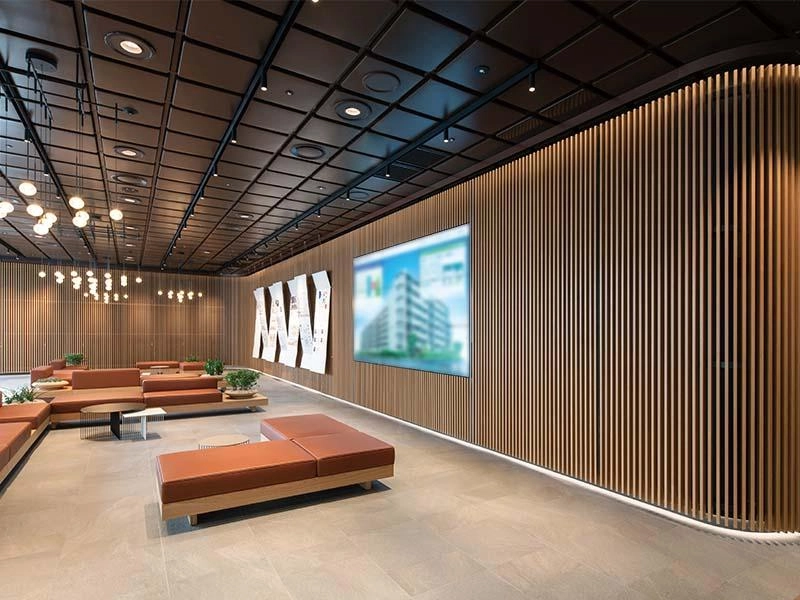
Match the Materials to Each Commercial Area
One wall-and-floor combination should not automatically be used throughout an entire property. Each area has a different balance of visual, operational, and maintenance requirements.
| Commercial area | Recommended wall-and-floor approach |
|---|---|
| Reception | Feature wall with neutral, durable flooring |
| Office workspace | Low-contrast panels with low-glare flooring |
| Meeting room | Warm wall tones with a calm floor finish |
| Retail display area | Neutral flooring that does not compete with products |
| Hotel lobby | Related undertones with contrast in texture |
| Corridor | Easy-clean wall surfaces and high-traffic flooring |
| Restaurant | Washable wall finish with stain-conscious flooring |
WPC wall panels for offices should support a calm working environment. Excessive grain contrast can become distracting across large wall areas. In retail interiors, the floor should normally remain secondary so that products and display lighting hold attention. Hotel lobbies can accept stronger textures, but circulation routes still require commercial flooring designed for rolling luggage and repeated cleaning.
This zone-based approach also helps procurement teams decide where decorative wall panels add value and where a simpler finish will control cost.
Specify Wall and Floor Durability Separately
A visually coordinated package does not mean the wall and floor should be approved under the same performance criteria.
Commercial wall panel durability depends on panel thickness, density, surface cleanability, resistance to scratches, fixing method, corner impact, substrate condition, and batch consistency. Lower wall sections in corridors and restaurants may face contact from chairs, carts, and cleaning equipment, while upper feature walls experience much less physical wear.
Flooring performance should be reviewed through wear-layer thickness, slip resistance, rolling-load behavior, dimensional stability, stain response, cleaning instructions, and commercial warranty. Flooring in a reception or corridor faces continuous abrasion from grit and traffic, which is different from the occasional impact experienced by a wall panel.
Latitude Interiors lists the A003 panel with density options of 0.65 and 0.75 ton/m³, thicknesses of 5 mm and 8 mm, widths of 900 mm and 1,200 mm, and lengths from 2,400 mm to 3,600 mm. Buyers considering A003 fluted WPC wall panels for commercial interiors should confirm the final surface décor, dimensions, installation requirements, and approved control sample before bulk production.
Fire, VOC, and other technical documents should also correspond to the exact product configuration being ordered. A document issued for one panel structure should not be assumed to cover every thickness or finish.
Calculate the Complete Wall-and-Floor Budget
Commercial wall panel cost extends beyond the price per square meter. A realistic quotation should include panels, trims, internal and external corners, adhesive or fixing components, cutting waste, labor, packaging, freight, and replacement stock.
The flooring budget requires the same level of detail. Planks, underlay where required, transition profiles, subfloor preparation, installation waste, spare material, and future repair stock all influence the final project cost.
Panel length can change cutting efficiency, particularly around doors, ceilings, columns, and service openings. Flooring waste varies according to room shape, plank direction, and installation pattern. These factors should be discussed before the purchase order is finalized.
Coordinated procurement does not automatically produce the lowest unit price, but it can reduce repeated sampling, color communication, packaging coordination, and supplier handovers. Latitude Interiors describes wall panel and flooring manufacturing capabilities supported by a production base exceeding 40,000 square meters, 25 production lines, and an independent research laboratory. These resources are relevant to customized dimensions, sample preparation, inspection, and batch management for wholesale and contract projects.
Approve Physical Samples Before Bulk Production
Digital images are suitable for initial screening but not for final approval. Camera settings, screen brightness, editing, and ambient light can shift undertones and hide surface gloss.
The wall panel sample should be viewed vertically, while the flooring sample should be placed horizontally. Light reaches these surfaces at different angles, so a pair that appears coordinated when laid flat may look different after installation.
Matching wall and flooring samples should be checked under daylight, warm-white light, cool-white light, and any decorative lighting specified for the project. A fluted panel should also be examined from several angles because the grooves create changing highlights and shadows.
For larger projects, the commercial interior material sample board should include wall panels, flooring, paint, trims, joinery, countertop materials, and furniture fabrics. A mock-up room or full-size sample area is preferable for hotels, restaurants, and chain retail projects.
After approval, the control samples should be signed, coded, photographed, and retained. The purchase order should reference those samples, and spare panels and flooring should be supplied from the approved batch where possible. This process reduces disputes over WPC wall panel batch color consistency after delivery.
Complete a Final Technical and Visual Check
Before placing an order, the project team should confirm that the wall and floor undertones coordinate, one surface has been selected as the visual focus, and both materials suit the intended commercial area.
Technical documents should be checked against the exact wall panel and flooring SKUs. The quotation should cover accessories, installation requirements, waste allowances, packaging, freight, samples, and spare stock. Production should begin only after dimensions, décor, finish, and control samples have been approved in writing.
This final review is especially important when sourcing a wall panel and flooring package for several floors, multiple stores, or phased hotel renovations. Small differences that appear manageable in one room become much more visible when repeated across hundreds of square meters.
Conclusion
Matching WPC wall panels with commercial flooring requires controlled coordination rather than exact duplication. Related undertones, balanced grain, appropriate gloss, and a clear visual hierarchy usually produce the strongest result.
The wall and floor should be evaluated together as a design package but approved separately as technical products. Accurate budgeting, physical sample review, actual project lighting, batch control, and retained reference samples all reduce risk during production and installation.
Designers, contractors, distributors, and developers can request coordinated wall and flooring samples from Latitude Interiors to compare finishes, dimensions, and project specifications before confirming a commercial order.
Frequently Asked Questions
Q1: Should WPC wall panels match the flooring exactly?
A: WPC wall panels and flooring do not need to be identical. Related undertones with a controlled difference in lightness, grain, or texture usually create a more balanced commercial interior.
Q2: What flooring goes with wood-grain WPC wall panels?
A: Neutral SPC flooring, restrained wood-look flooring, and stone-look flooring can all work with wood-grain WPC wall panels. The best choice depends on the wall color, grain strength, lighting, traffic level, and purpose of the space.
Q3: Can dark WPC wall panels be used with dark flooring?
A: Dark wall panels and dark flooring can work in large, well-lit interiors, but contrast should be introduced through ceilings, furniture, trims, lighting, or secondary finishes. In smaller commercial spaces, a lighter floor usually gives the room better visual balance.
Q4: How should commercial buyers approve matching wall and flooring samples?
A: Physical samples should be reviewed together under the project’s actual lighting. A material board or mock-up should then be approved, coded, photographed, and retained as the control reference for production and delivery inspection.
Q5: Do WPC wall panels and flooring need the same durability rating?
A: No. Wall panels are assessed for impact, cleanability, fixing, surface quality, and relevant fire or emission requirements. Flooring must also address abrasion, rolling loads, slip resistance, dimensional stability, and commercial traffic.


