
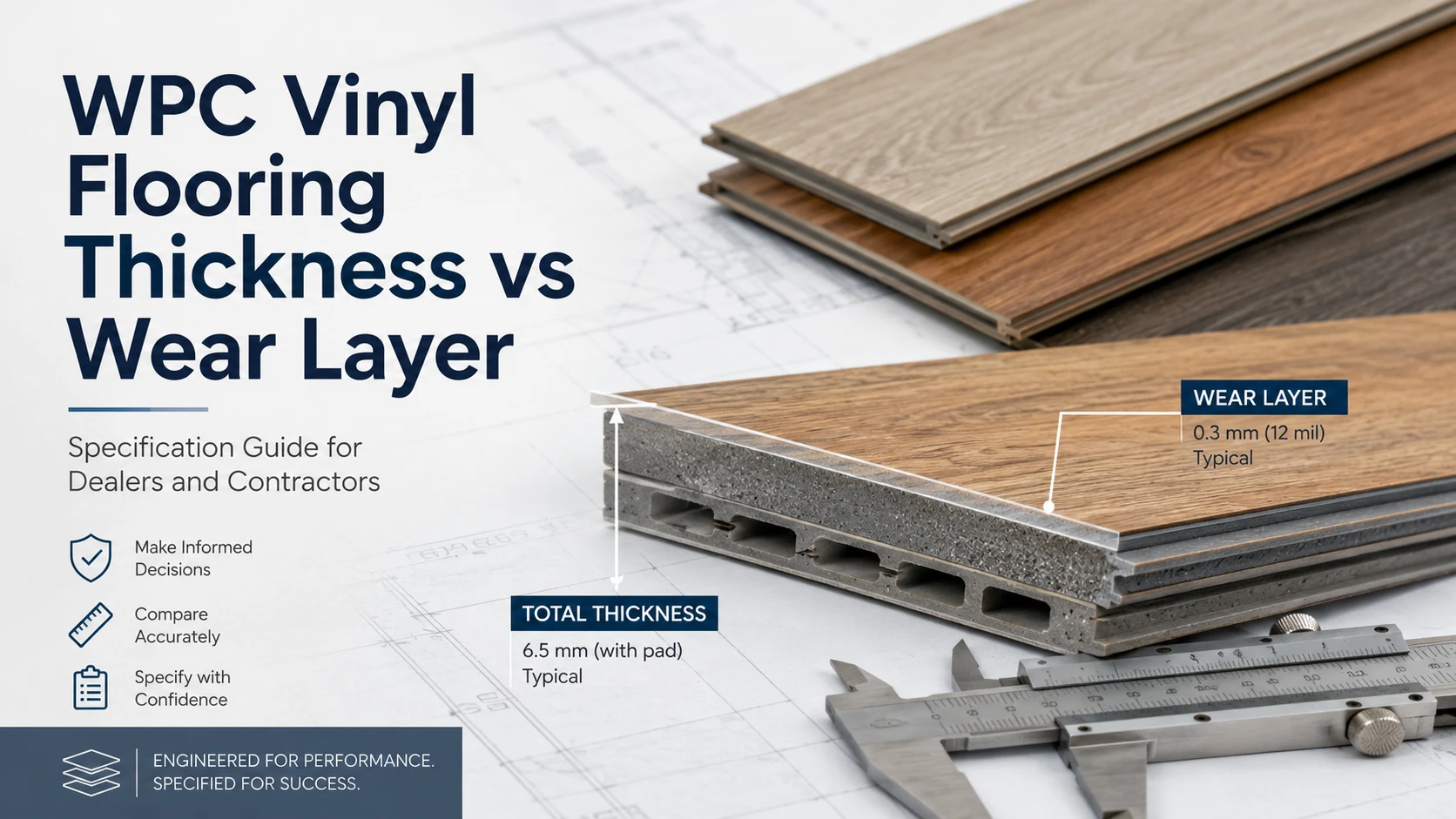
WPC vinyl flooring thickness vs wear layer is not a choice between two competing numbers. Total thickness describes the complete plank build-up; the wear layer is the clear surface layer intended to protect the printed design from everyday wear. Dealers and contractors need both figures, but neither proves project suitability alone. The correct specification depends on floor height, core and backing construction, traffic, cleaning, furniture movement, installation conditions, and exact product documentation.
WPC Flooring Thickness vs Wear Layer: What Each Specification Means
Total Thickness, Core Thickness, and Attached Backing Are Different Measurements
Total plank thickness may include the decorative layers, WPC core, and attached backing. Core thickness refers only to the structural core, while backing thickness describes an IXPE, EVA, or other pad beneath the plank. Two products advertised as 6 mm may therefore use different cores or backing arrangements.
For renovation work, total thickness affects door clearance, transitions, and alignment with adjacent finishes. Request separate values for total thickness, core thickness, wear layer, and backing, then confirm whether the stated total includes the pad. Latitude Interiors lists WPC flooring configurations with board thicknesses from 4.0 to 8.0 mm and optional IXPE or EVA backing, illustrating why the quoted construction matters more than the headline thickness. Buyers can review WPC vinyl flooring options before selecting a specific build-up.
The Wear Layer Protects the Surface, Not the Whole Plank
The wear layer sits above the printed décor and addresses surface wear. It does not describe the core, locking profile, backing, indentation recovery, or substrate compatibility. Surface coating and wear-layer thickness are also different specifications.
A thicker wear layer may help where abrasive dirt, frequent cleaning, or repeated circulation increases surface wear. It does not automatically prevent concentrated-load dents or joint damage. Compare it with the finish, intended application, maintenance instructions, warranty, and test evidence.
How to Choose WPC Flooring Thickness for a Project
Choose Total Thickness from Floor Build-Up and Installation Constraints
Record the substrate, finished floor-height limit, door clearance, transitions, installation method, and whether backing is included. Verify any underfloor heating, moisture control, or separate underlayment against the exact product instructions.
A thicker plank cannot correct a weak, wet, moving, or excessively uneven subfloor. Extra soft underlayment beneath attached backing may also change joint support. Resolve these conditions before comparing price per square foot.
Compare 5 mm, 6 mm, and 8 mm Products Only When Construction Is Equivalent
A useful 5 mm vs 6 mm vs 8 mm WPC flooring comparison requires the same measurement basis. Check whether products use equivalent cores, wear layers, backing, locking systems, formats, and installation methods. If one 6 mm product includes a pad while another excludes backing, the figures are not directly comparable.
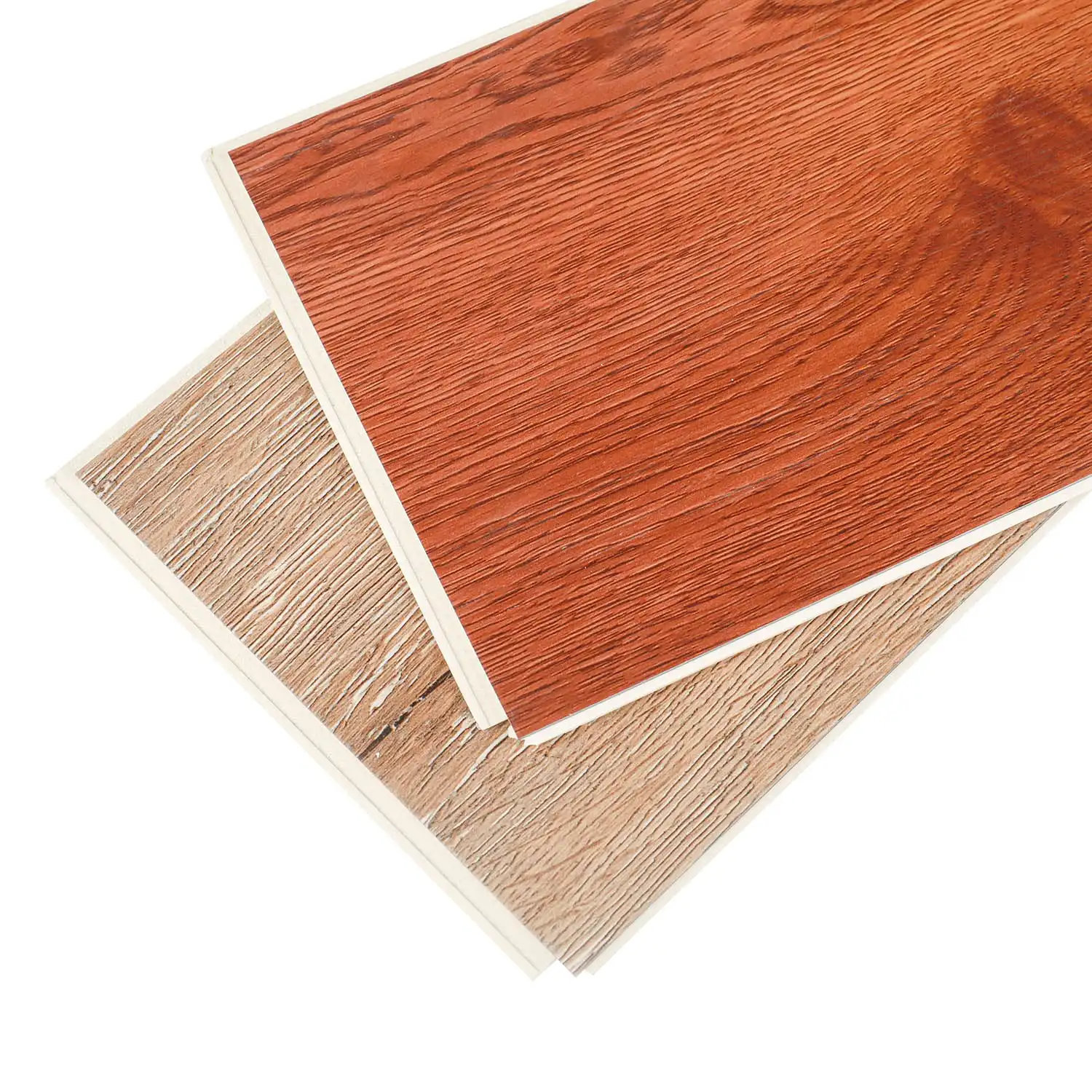
Thickness should not be the only good-better-best ladder. A thicker plank with a lighter wear layer may solve a different need from a thinner plank with a heavier surface specification. Latitude Interiors’ 5 mm and 6 mm WPC flooring range lists multiple construction fields, so the final combination should be written into the quotation and sample approval.
How to Choose Between 0.3 mm and 0.5 mm WPC Wear Layers
Match the Wear Layer to Traffic, Cleaning, and Replacement Risk
A 0.3 mm wear layer may be considered for lower-risk interiors when the exact documentation supports the use. A 0.5 mm wear layer may be evaluated where circulation, cleaning, tenant turnover, or abrasion is greater. These are selection prompts, not automatic application ratings.
Traffic count alone is insufficient. Entrance grit, rolling chairs, and frequent furniture relocation create different wear patterns. Record each area’s operating condition and confirm that the SKU, surface construction, maintenance method, and warranty match it. Dealers should separate products by the problem they solve, not merely by wear-layer number.
Why a 20 Mil Label Is Not a Complete Commercial Specification
A mil is one-thousandth of an inch. NIST lists 1 mil as 0.0254 mm, so a 0.5 mm wear layer is approximately 19.7 mil and is commonly discussed as about 20 mil. Purchase documents should still record the supplier’s stated metric value, tolerance, and exact SKU.
A 20 mil description does not establish the core, joints, backing, substrate requirements, indentation behavior, or rolling-load suitability. Confirm the data sheet, intended use, instructions, maintenance guidance, and warranty.
Why Thicker WPC Flooring Can Still Fail
A Thicker Plank Cannot Correct an Unsuitable Subfloor or Underlayment
Click-lock flooring depends on continuous support. Low spots, loose substrates, moisture, or an unapproved soft pad can allow movement that stresses joints. A thicker plank may change how the floor feels, but it does not remove the need for a dry, stable, sufficiently flat substrate.
Compare the site with product instructions and document each underlayment or moisture-control layer. For conditions outside the documentation, request written guidance or use a controlled mock-up.
A Thicker Wear Layer Does Not Prevent Core Indentation or Joint Damage
Surface abrasion and concentrated loading are different failure mechanisms. ASTM F970 addresses indentation recovery of uninstalled resilient flooring and notes that this does not indicate installed performance. ASTM F2753 evaluates dynamic rolling-load effects on resilient floor-covering systems and may include joints, adhesives, and underlayments.
For heavy furniture, rolling chairs, carts, or mobile equipment, provide load per contact point or wheel, wheel details, movement frequency, turns, and dwell time. Verify that the evidence represents the proposed assembly; a wear-layer upgrade is not a substitute.
How to Compare Quotations and Choose a WPC Flooring Supplier
Normalize the Specification Before Comparing Prices
| RFQ field | Supplier information required | Buyer check |
|---|---|---|
| Product code | Unique quoted SKU | Match sample and documents |
| Total/core thickness | Values stated separately | Confirm backing inclusion |
| Wear layer | Value in mm and mil | Check tolerance and rounding |
| Backing | Type and thickness | Attached or separate |
| Installation | Exact system | Match project conditions |
| Intended use | Written statement | Match traffic and maintenance |
| Documents | Data sheet, instructions, warranty, reports | Apply to quoted SKU |
This prevents comparisons between a pad-included 6 mm plank and a core-only 6 mm figure, or between 0.5 mm and 20 mil without checking conversion.
Require Exact-SKU Documents Instead of Generic Commercial Claims
Ask for the technical data sheet, installation and maintenance instructions, warranty, sample, and any wear, indentation, acoustic, or rolling-load information required by the project. Check the product code, thickness, wear layer, backing, locking system, substrate, and test conditions.
Red flags include reports for another model, missing construction details, conflicting product data, or a “commercial grade” claim without defined conditions. Use a mock-up when site conditions differ materially from the documented assembly.
Choose Suppliers by Specification Clarity and Project Support
A qualified supplier should ask about application, traffic, substrate, installation, quantity, sample approval, documentation, and replacement needs before confirming a product.
Latitude Interiors presents WPC flooring products alongside sample acquisition, OEM/ODM, quality-inspection, packaging, transportation, and business-support sections. Its published range includes customizable colors and sizes, several board-thickness values, 0.3 mm and 0.5 mm wearing-layer options, UV-coated finishes, and IXPE or EVA backing options. Each final combination should still be confirmed in writing for the quoted SKU.
Conclusion
WPC vinyl flooring thickness and wear layer should be specified as separate parts of a complete construction. Total thickness helps manage floor build-up, backing comparisons, transitions, and installation constraints. The wear layer helps address surface exposure. Neither value independently proves commercial suitability, indentation resistance, joint performance, or jobsite compatibility.
Before ordering, normalize every quotation, verify the exact SKU, review the substrate and use conditions, and match all documents to the proposed construction. Project buyers can request a WPC flooring specification review by submitting the application, dimensions, target wear layer, backing preference, installation method, substrate condition, quantity, sample requirements, and required documents.
WPC Flooring Thickness and Wear Layer FAQs
Is a 0.5 mm wear layer the same as 20 mil?
Approximately. A 0.5 mm layer converts to about 19.7 mil. Confirm the stated value, tolerance, and exact product rather than relying only on a rounded label.
Is 8 mm WPC flooring better than 6 mm?
Not automatically. Compare core thickness, attached backing, wear layer, locking system, installation method, floor-height limits, intended application, and warranty.
Does WPC flooring thickness include the attached pad?
It may or may not. Require total thickness, core thickness, backing type, and backing thickness as separate quotation fields.
What wear layer should be specified for commercial WPC flooring?
It depends on traffic, abrasive dirt, cleaning, furniture movement, replacement planning, and exact product documentation. A commercial label alone is insufficient.
What belongs on a WPC flooring purchase order?
Include the exact SKU, total and core thickness, wear layer in mm and mil, backing, dimensions, finish, installation system, quantity, packaging, sample approval, intended application, documents, and warranty.