SPC wall panels over existing tile can be a practical option in commercial renovations, but only when the existing tiled wall is suitable for bonding and the complete installation system is properly specified. The key question is not simply, “Can SPC wall panels be installed over existing tile?” Contractors and maintenance teams also need to determine whether the tiles are firmly bonded, sufficiently flat, dry, and clean; whether the selected adhesive is compatible with both surfaces; and how joints, corners, edges, and plumbing penetrations will be detailed in wet areas.
Covering a defective tiled wall may hide a problem temporarily rather than solve it. A pre-installation inspection should come before product ordering.
Can SPC Wall Panels Be Installed Directly Over Existing Tile?
Existing ceramic or porcelain tile may be a usable substrate for some SPC wall panel systems when the surface is structurally sound and properly prepared. Published SPC installation guidance commonly requires the substrate to be flat, clean, stable, and free of contaminants or old adhesive residue. Specific over-tile approval, however, should be verified against the selected panel and adhesive specifications.
For commercial projects, this distinction matters because avoiding tile demolition may reduce disruption, debris, and additional wall reconstruction, but overlay installation should not be used to conceal an unstable substrate.
| Existing Tile Condition | Recommended Decision | Main Risk to Check |
| Firm, flat, dry, and clean | Consider overlay | Adhesive compatibility |
| Glossy but firmly bonded | Prepare surface as specified | Poor adhesion |
| Deep grout lines or excessive lippage | Correct surface first | Incomplete adhesive contact |
| Isolated damaged tiles | Repair before overlay | Local movement |
| Multiple hollow or loose tiles | Repair or remove affected system | Bond failure |
| Active leakage or damp substrate | Correct moisture source first | Hidden moisture damage |
When Existing Tile Can Be Used as the Substrate
An existing tiled wall is a stronger overlay candidate when the tiles remain firmly attached, the wall has no active moisture problem, and surface irregularities are within the requirements of the selected installation system.
The inspection should cover more than visible cracks. Contractors should check for loose or hollow areas, movement around openings, deteriorated grout, contamination, and transitions between different substrates. A tile that looks intact can still have poor attachment beneath it.
Before choosing SPC wall panels for commercial renovations, confirm that the exact panel is intended for the project environment and that over-tile installation is supported by the relevant installation instructions.
When Tile Should Be Repaired or Removed Before Panel Installation
SPC wall panels should not be treated as a corrective layer for a failing wall. Multiple loose or hollow tiles, active leakage, severe unevenness, unstable backing, or widespread cracking can indicate a problem that should be repaired before new panels are installed.
Isolated defects may sometimes be repaired locally, depending on the existing construction. Widespread failure usually requires a broader assessment.
This is particularly important in hotel bathrooms, apartment renovations, public washrooms, and other multi-room projects. Repeating the same installation over an unsuitable substrate can multiply a small site-assessment error across dozens of rooms.
How to Inspect Existing Tile Before Installing SPC Wall Panels
A successful adhesive installation depends heavily on what sits behind the new panel. The substrate should therefore be assessed before panel quantities, accessories, and installation schedules are finalized.
Check Tile Bonding, Cracks, and Hidden Moisture Risks
Loose tiles, hollow-sounding areas, cracked sections, and visible movement should be investigated rather than simply covered. The underlying cause may be local impact damage, poor original bonding, substrate movement, or moisture-related deterioration.
Wet areas require additional caution. If staining, persistent dampness, failed sealant, or leakage is visible, the source should be identified before installation. An SPC panel may resist moisture, but it cannot repair a leaking pipe, unstable backing board, or failed waterproofing layer behind the original tile.
The practical rule is simple: the new wall panel can only perform as reliably as the surface carrying the adhesive.
Check Flatness, Grout Lines, and Tile Lippage
Grout lines do not automatically prevent wall panels from being installed over tile, but the overall wall must provide sufficient contact for the specified adhesive. Deep joints, projecting tile edges, and significant lippage can create unsupported areas behind a rigid panel.
Installers should check the wall with an appropriate straightedge and identify high and low areas before work begins. Large-format panels should not be expected to flatten a severely uneven tiled wall by themselves.
The acceptable flatness tolerance and any required surface correction should come from the selected panel and adhesive documentation rather than a generic rule applied to every SPC product.
How Should Existing Tile Be Prepared for SPC Wall Panel Adhesive?
A firmly bonded wall can still fail if its surface prevents the adhesive from developing a reliable bond.
Cleaning, Degreasing, and Surface Preparation
Bathroom and commercial tiles may carry soap residue, grease, cleaning chemicals, silicone, dust, or previous adhesive contamination. These materials can create a weak layer between the tile and new adhesive.
Glossy or glazed tile may also require additional preparation. Published installation guidance for some SPC systems calls for thorough degreasing and mechanical surface preparation before bonding over existing tile, but those instructions are product-specific and should not automatically be applied to every Latitude Interiors panel.
The safer approach is to identify the existing tile surface, clean it thoroughly, and then follow the approved preparation method for the selected adhesive and SPC wall panel combination.
How to Confirm Adhesive and Primer Compatibility
The correct question is not, “What is the strongest construction adhesive?” It is whether the adhesive is approved to bond the specific SPC panel backing to the existing ceramic, porcelain, stone, or other substrate.
Primer requirements can also vary. Some installations may require surface priming or mechanical preparation, while another approved adhesive system may use a different procedure. Temperature, moisture conditions, application method, and curing requirements should also be checked against the adhesive technical documentation.
For procurement teams, adhesive compatibility should be confirmed before bulk material reaches the project—not left to an installer to resolve after delivery.
Do SPC Wall Panels Need Additional Waterproofing Over Tile?
Moisture-resistant or waterproof panel construction does not automatically make an entire shower wall assembly watertight.
Waterproof Panel vs. Watertight Wall Assembly
Water can bypass a panel through joints, perimeter edges, corners, cutouts, or penetrations. Technical SPC installation guidance specifically notes that moisture can move through panel joints and that wet-area installations may still require an appropriate waterproofing system.
This is why a decorative wall in a dry hotel corridor and an SPC shower wall panel installation should not use the same risk assessment. In a wet zone, the complete assembly—including the existing substrate—needs to be considered.
For additional bathroom-specific planning, SPC wall panels for bathroom renovations provides a useful application-level reference.
Seal Joints, Corners, Edges, and Fixture Penetrations
The highest-risk details are often the places where panels stop or are cut: panel-to-panel joints, internal corners, external corners, bottom edges, shower tray or tub transitions, and openings for mixers, faucets, pipes, or other fixtures.
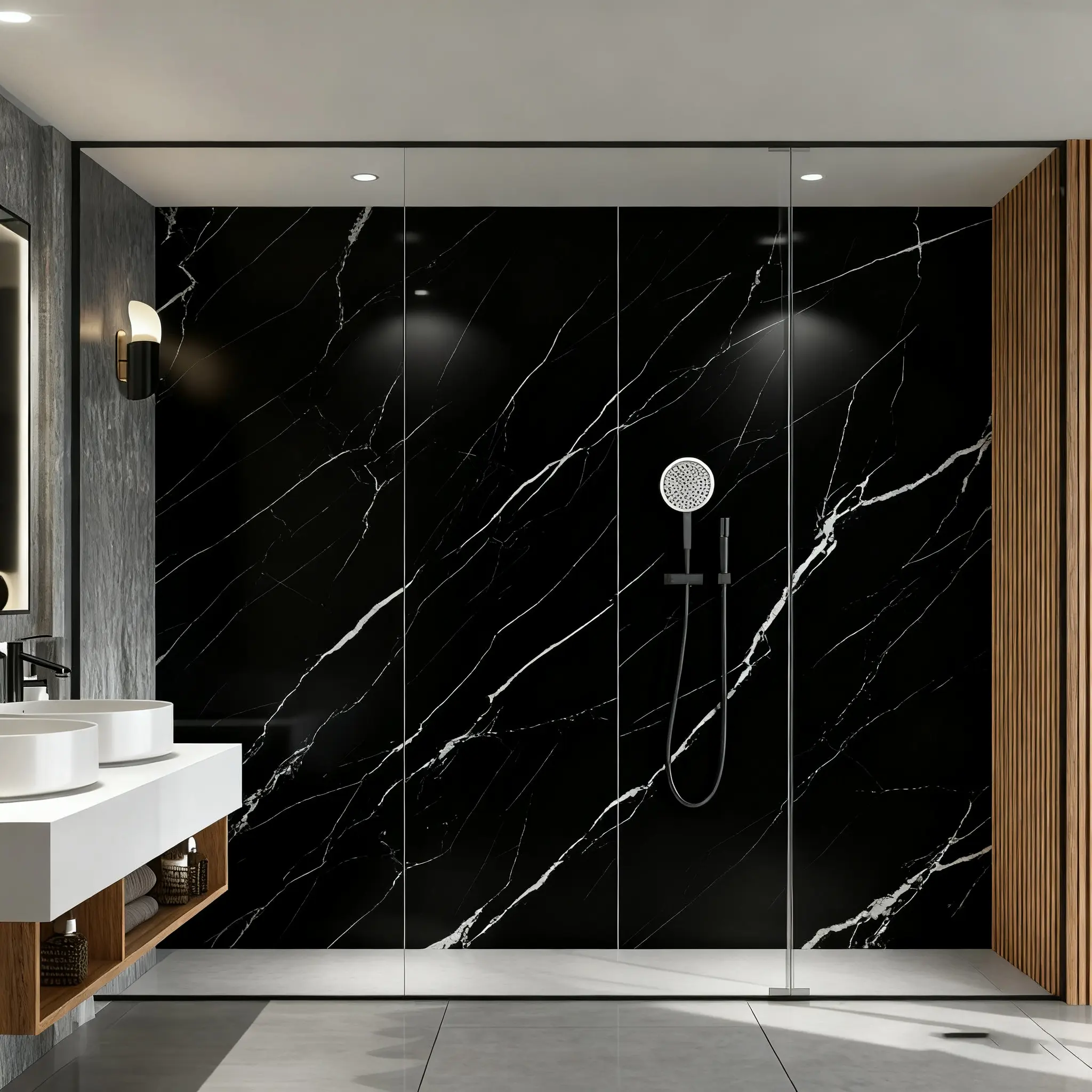
The required sealant, trim, spacing, and waterproofing detail should match the selected panel system. Generic silicone advice should not replace product-specific installation instructions.
Latitude Interiors lists a commercial SPC shower wall panel system for contractors and hotels with installation/accessory instruction options and configurable shower-related accessories. These details should be reviewed during specification rather than after the panels arrive on site.
Common Failure Risks When Installing SPC Wall Panels Over Tile
Most over-tile failures can be traced to a small group of avoidable decisions: bonding to loose tile, leaving grease or silicone contamination on the wall, ignoring excessive lippage, selecting an adhesive without checking both substrates, or covering unresolved moisture damage.
Wet areas add further risks. Poorly sealed joints, incomplete corner details, and unsealed fixture penetrations may allow water to reach the assembly behind the panel.
For commercial renovations, prevention should happen at the site-survey stage. If a condition is uncertain, record it, photograph it, and resolve it with the installer, adhesive supplier, or panel supplier before material approval.
Commercial Renovation Checklist Before Ordering SPC Wall Panels
Once the existing tiled wall has been assessed, procurement can move from “Can this be covered?” to “Which system and accessories should be quoted?”
What Contractors Should Record During Site Inspection
A useful site record should include the project type, wet or dry location, existing tile type, wall dimensions, and photographs of representative wall conditions. It should also identify loose or cracked areas, grout and lippage conditions, inside and outside corners, plumbing penetrations, shower tray or tub transitions, and the estimated panel quantity.
Photos are especially valuable in renovation work because a supplier cannot assess “existing tile” as a single uniform condition. One wall may be flat and firmly bonded while another area in the same room shows movement or previous moisture damage.
Latitude Interiors offers multiple SPC wall panel products through its SPC wall panels for commercial renovations category, including bathroom and shower-oriented options. Product suitability should still be confirmed for the specific application.
What to Confirm With the SPC Wall Panel Supplier Before the RFQ
Before comparing quotations, request confirmation of the exact panel construction and dimensions, substrate requirements, over-tile suitability, recommended adhesive approach, primer requirements where applicable, joint and wet-area details, trims, accessories, samples, and installation documentation.
A useful supplier discussion should cover the complete wall assembly rather than only the panel sheet.
Latitude Interiors publicly lists sample acquisition, quality inspection, packaging and transportation, and after-sales functions alongside its SPC wall panel range. Those capabilities can support the procurement process, but technical installation requirements still need to be matched to the selected product and site conditions.
Conclusion
SPC wall panels over existing tile can be a viable renovation approach when the existing wall is stable, sufficiently flat, properly prepared, and compatible with the specified adhesive and wet-area detailing. The decision should be based on the entire wall assembly—not simply on whether the SPC panel itself resists moisture.
For a commercial project review, contact Latitude Interiors with wall dimensions, application type, existing-tile photos, wet or dry location, required quantity, drawings, and details of corners or fixture penetrations. This gives the supplier enough context to discuss an appropriate panel and accessory configuration without assuming that every tiled wall can use the same installation method.
FAQs About Installing SPC Wall Panels Over Existing Tile
Can SPC wall panels be installed directly over ceramic tile?
Some SPC wall panel systems can be installed over firmly bonded ceramic tile. The wall should be clean, dry, sufficiently flat, and structurally sound, and the selected adhesive must be compatible with both the panel and tile substrate. Product-specific installation instructions should be checked before work begins.
Do I need to sand tile before installing SPC wall panels?
Not every system uses the same preparation method. Glossy or glazed tile may require mechanical preparation, priming, or another specified treatment to develop adequate adhesion. Follow the selected SPC panel and adhesive requirements rather than assuming that every tiled wall should be sanded identically.
What adhesive should I use for SPC wall panels over tile?
Use an adhesive approved for both the SPC panel backing and the existing tile substrate. Ceramic, porcelain, glazed surfaces, and wet-area applications may have different requirements. Confirm adhesive type, primer needs, application method, and curing conditions before procurement or installation.
Are SPC wall panels waterproof enough for shower walls?
Water-resistant panel construction is only one part of a wet-area installation. Joints, corners, perimeter edges, fixture penetrations, and transitions also need the appropriate sealing or waterproofing detail. The complete shower wall system should be verified against the product and installation specifications.