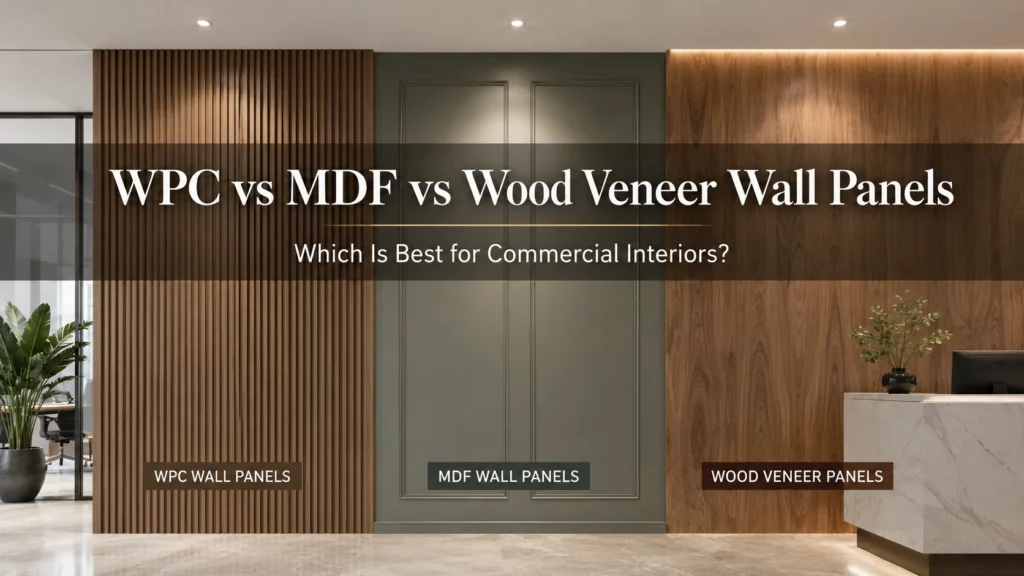
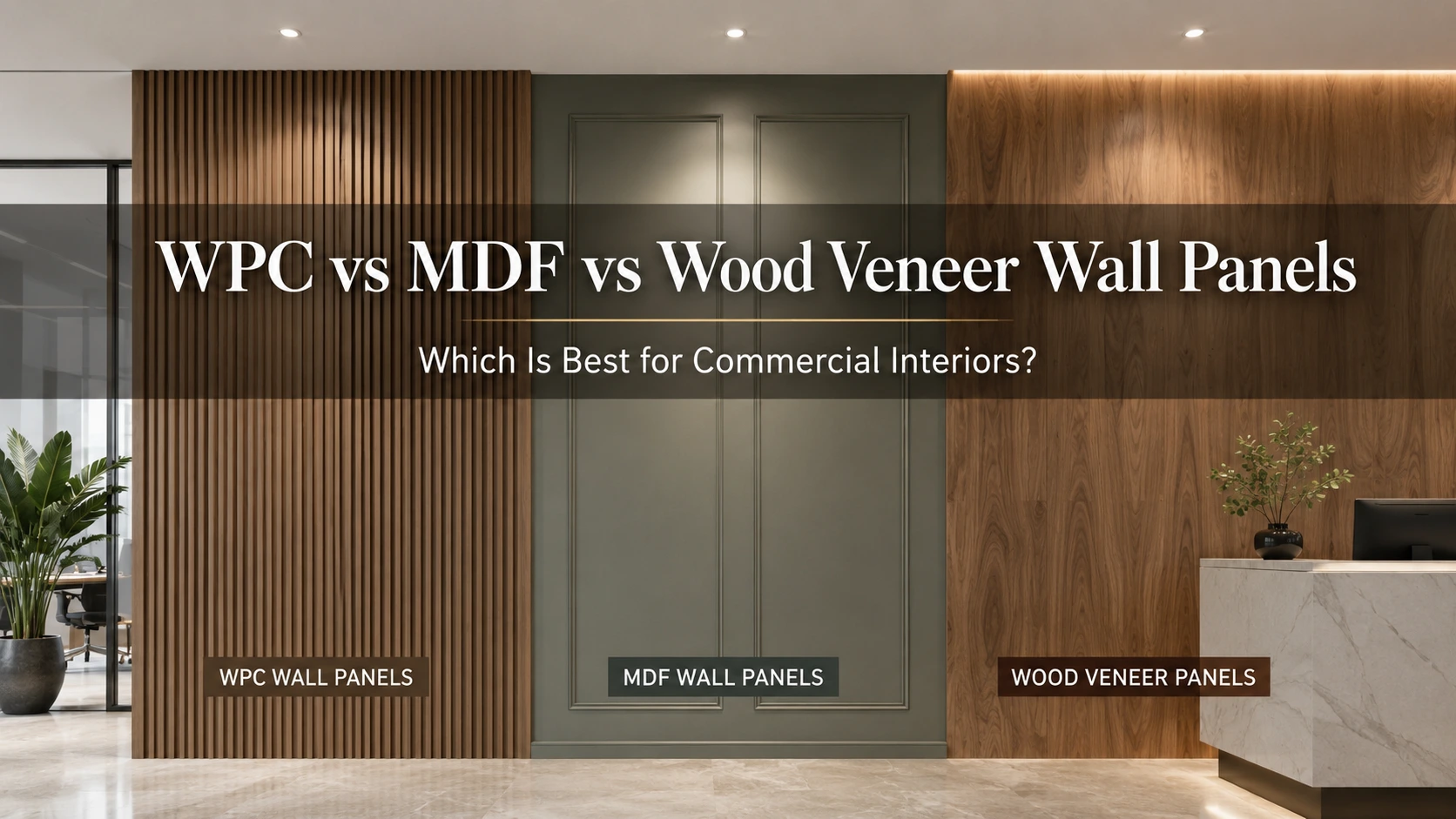
Choosing between WPC, MDF, and wood veneer wall panels is rarely a question of which material is universally better. For commercial interiors, the right choice depends on moisture exposure, traffic, appearance requirements, installation conditions, maintenance expectations, and total project cost. A buyer comparing WPC vs MDF wall panels should also consider whether the project prioritizes a factory-finished decorative surface, custom machining, or the appearance of real wood.
The most useful approach is to compare the complete wall panel system—not just the material name—and then verify the actual product specification before ordering.
WPC vs MDF vs Wood Veneer Wall Panels: Quick Comparison
For procurement teams, contractors, and interior specifiers, the first decision should be based on the operating environment and design requirement.
| Selection Factor | WPC Wall Panels | MDF Wall Panels | Wood Veneer Panels |
| Humidity exposure | Worth considering, subject to product specification | Standard MDF requires more caution; grade matters | Depends strongly on substrate, adhesive, and finish |
| High-traffic interiors | Surface performance should be verified | Performance depends on finish and construction | Finish and substrate affect durability |
| Natural wood appearance | Decorative wood-look finishes available | Usually requires an applied finish | Suitable when genuine wood grain is required |
| Custom routing or painting | Depends on panel profile and construction | Often suitable for custom machining and painted finishes | Usually selected for the veneer appearance rather than heavy routing |
| On-site finishing | May be reduced with factory-finished panels | Frequently requires additional finishing | Depends on fabrication and finishing system |
| Batch appearance | Samples and production batches should be checked | Usually controllable through the finish specification | Natural grain and color variation should be expected |
| Typical decision driver | Practical decorative wall system | Custom finishing and dry-area applications | Premium natural-wood appearance |
This is why the answer to “is WPC better than MDF for commercial interiors?” changes from project to project. A reception feature wall, a frequently cleaned corridor, and a custom-painted boardroom wall can require different materials even within the same building.
Buyers considering WPC can review available WPC wall panels for commercial interiors before narrowing the specification to a particular panel size, surface, or application. Latitude Interiors currently lists WPC wall panel products with published fields including density, thickness, width, and length, although the appropriate specification still needs to be matched to the project.
Why WPC, MDF, and Wood Veneer Perform Differently
Material comparisons become misleading when WPC, MDF, and wood veneer are treated as three completely equivalent constructions.
Core Material vs Surface Finish: What Commercial Buyers Are Actually Comparing
MDF is primarily a panel substrate, while real wood veneer is a thin natural-wood surface that can be bonded to substrates such as MDF or plywood. Architectural veneer suppliers therefore specify both the veneer and the supporting panel construction rather than treating “wood veneer” as a complete structural description.
That distinction matters in procurement. Two products described as wood veneer wall panels may use different cores, adhesives, finishes, edge treatments, and installation systems. Their response to humidity, impact, cleaning, and replacement may therefore differ.
Before comparing MDF vs wood veneer wall panels, request the full construction. Confirm the core material, veneer species or decorative surface, finish, panel dimensions, edge treatment, and fixing method. Comparing only surface appearance can hide the factors that determine installation and long-term performance.
How Do WPC, MDF, and Wood Veneer Compare in Commercial Projects?
Commercial wall panel selection becomes easier when the comparison starts with actual operating conditions rather than a generic advantages-and-disadvantages list.
Moisture, Cleaning, and High-Traffic Conditions
Humidity and routine cleaning are important when selecting wall panels for restaurants, corridors, reception areas, retail interiors, and other frequently maintained spaces. Standard MDF should be evaluated carefully where moisture can reach exposed edges or unfinished surfaces. Moisture-resistant MDF grades may change that assessment, so the exact grade matters.
WPC can be considered where moisture resistance and easier surface maintenance are priorities, but “WPC” alone is not a performance specification. Buyers should confirm the exact panel’s intended application, surface construction, cleaning compatibility, and installation requirements.
Real wood veneer panels need similar scrutiny. Their suitability depends not only on the veneer but also on the substrate and protective finish.
For high-traffic wall panels, ask a more useful question than “Which material is strongest?” Determine how often the wall will be touched, cleaned, struck by carts or furniture, and whether individual damaged panels can be replaced without creating a visible mismatch.
Appearance, Finish Consistency, and Customization
Wood veneer is a logical candidate when genuine grain, natural variation, and an architectural wood finish are central to the design brief. The same natural variation, however, means buyers may need to control grain direction, sequence, color range, and replacement matching.
MDF can suit projects requiring painted surfaces, routed details, or customized decorative fabrication, provided the selected grade and finish suit the environment.
WPC occupies a different position. Wood-look, fluted, and other decorative surfaces can make it useful where the project requires a repeatable finished appearance without specifying genuine natural wood. For multi-room or multi-location projects, physical samples and production-batch consistency become particularly important.
An office project provides a useful example. Reception walls may emphasize appearance, while corridors add maintenance and traffic considerations. The guide to WPC wall panels for office interiors covers these commercial application and procurement questions in more detail.
Installation, Maintenance, and Lifecycle Cost
A WPC vs MDF cost comparison should not stop at the panel price. Commercial buyers usually need to compare material, fabrication, wall preparation, finishing, installation labor, accessories, maintenance, downtime, and eventual replacement.
A lower-cost board can become less economical if it requires significant on-site finishing or creates operational disruption during future maintenance. Conversely, paying more for a material feature that the project does not need may add cost without adding practical value.
Before comparing quotations, ask each supplier what is included. Does the price cover finished panels only? Are trims or fixing accessories separate? Is additional painting or sealing required? How should damaged panels be replaced? Can matching material be supplied for later phases?
This lifecycle view is especially useful for chain stores, phased renovations, hotels, offices, and other projects where installation consistency and future maintenance matter alongside initial purchasing cost.
Which Wall Panel Material Should You Choose for Your Project?
There is no single answer to “which wall panel is better.” The selection should follow the dominant project requirement.
Choose WPC When Performance and Project Repeatability Matter
WPC is worth evaluating when a commercial project needs a decorative finished wall panel, consistent visual treatment across multiple areas, and practical maintenance characteristics. It may also suit projects where reducing additional on-site finishing is valuable.
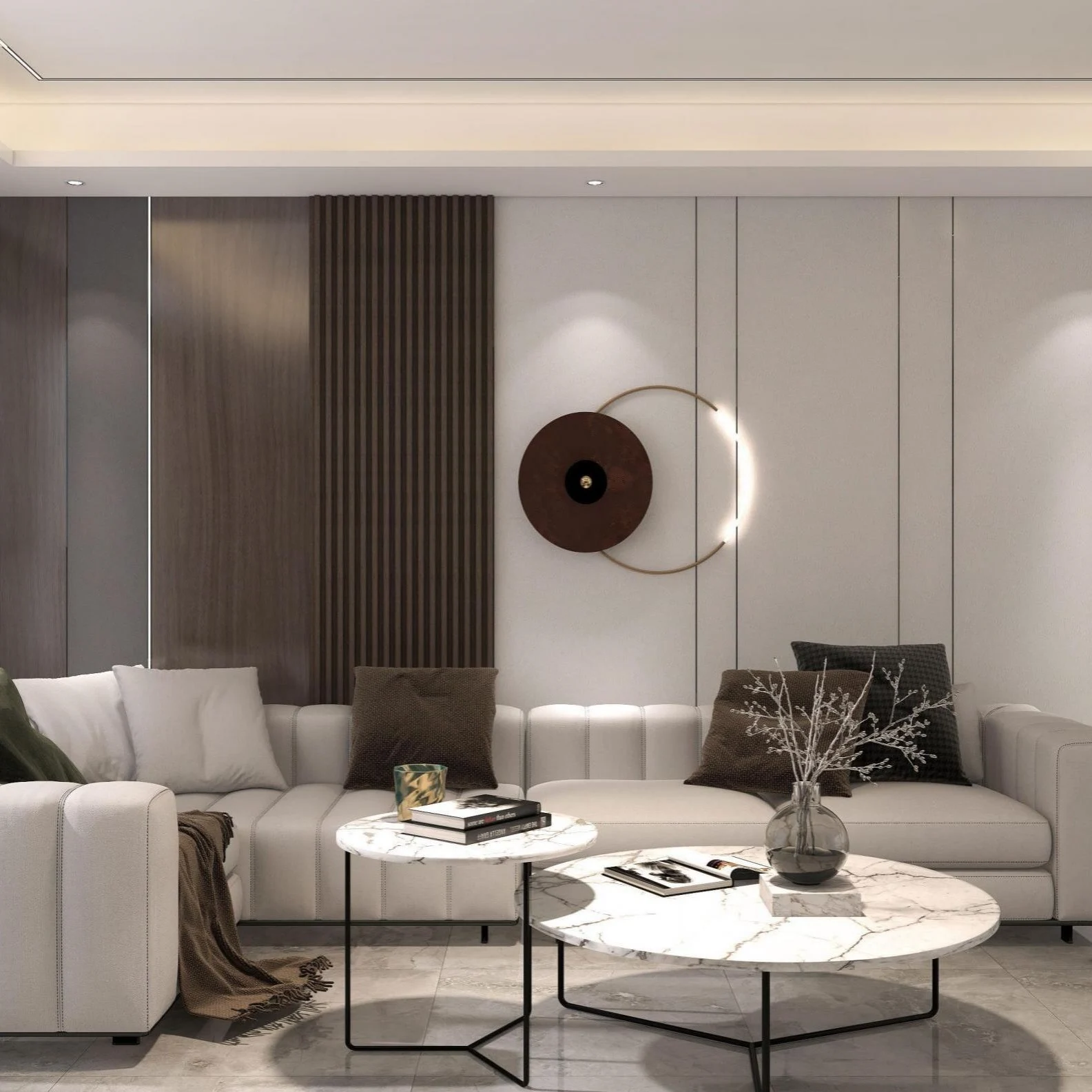
It should not be selected solely because the product name says WPC. Before bulk ordering, verify dimensions, surface finish, installation method, samples, and any project-required technical documentation.
Choose MDF When Dry Conditions and Custom Finishing Matter
MDF can be a practical option for controlled interior environments where custom routing, painting, fabricated details, or a specific applied finish is the primary requirement.
The main purchasing risk is treating all MDF as interchangeable. Buyers should confirm the grade, thickness, surface treatment, exposed-edge protection, and environmental conditions. If moisture exposure is expected, the material specification needs additional review rather than assuming standard MDF is suitable.
Choose Real Wood Veneer When Natural Grain Is a Design Requirement
Real wood veneer makes sense when genuine wood grain is a defining architectural requirement—for example, selected feature walls, executive areas, or premium reception spaces.
The trade-off is that natural variation must be managed rather than treated as a defect. Buyers should confirm the substrate, veneer selection, grain direction, finishing system, approved sample, and approach to future replacement. A project demanding extremely uniform appearance across many locations may need especially careful sample and batch planning.
How to Avoid the Wrong Wall Panel Choice Before Bulk Ordering
One of the most common procurement mistakes is comparing prices before defining operating conditions.
Start by documenting where the panel will be installed, expected humidity, cleaning method, traffic level, wall substrate, design finish, installation schedule, and replacement requirements. Then translate those conditions into measurable product requirements.
This prevents a project from using one specification everywhere simply because one material was approved for a feature wall. A lobby, meeting room, service corridor, and frequently cleaned food-service area may require different risk assessments.
The sequence should be simple: define the environment, shortlist the material system, approve a representative sample, verify specifications, and only then compare commercial quotations.
What Should B2B Buyers Confirm With a Wall Panel Supplier?
Once the material direction is clear, supplier evaluation becomes the next risk-control step.
Request Comparable Specifications, Samples, and Project Support
Quotations are useful only when suppliers are quoting comparable requirements. A purchasing team should request panel construction, dimensions, finish, installation information, accessories, relevant technical documents, packaging details, physical samples, and information on batch consistency and replacement material.
For WPC procurement, the WPC wall panel supplier quality checklist provides a deeper framework for reviewing density, thickness, surface film, color consistency, samples, and bulk-order controls. Latitude Interiors also identifies sample acquisition, quality inspection, packaging, transportation, and after-sales functions within its published service structure.
A useful supplier question is not simply “What is the lowest price?” It is: “Can the supplier document the same project requirements that are being used to compare every candidate?”
More information about the brand and product scope is available through Latitude Interiors before a project moves into detailed specification or RFQ preparation.
Conclusion
WPC, MDF, and wood veneer wall panels solve different commercial interior requirements. WPC is worth considering where a finished decorative system and repeatability matter; MDF can be appropriate for dry interiors requiring custom finishing; and real wood veneer is relevant when genuine natural grain is a core design requirement.
The safest purchasing decision comes from matching material construction to the actual environment, comparing lifecycle requirements rather than panel price alone, and verifying the specific product before bulk ordering.
For a project-level review, buyers can contact Latitude Interiors with the application, panel dimensions, preferred finish, drawings or reference images, estimated quantity, and any project-specific operating conditions. That information allows the product discussion to start from real requirements rather than a generic material recommendation.
FAQs About WPC, MDF, and Wood Veneer Wall Panels
Is WPC better than MDF for commercial wall panels?
Not in every application. WPC may be worth prioritizing where moisture exposure, a finished decorative surface, or maintenance requirements matter. MDF may be more suitable in dry areas requiring painting, routing, or custom fabrication. The final choice should be checked against the actual product specification.
Is WPC better than real wood veneer?
They serve different design priorities. WPC can provide repeatable decorative wood-look finishes, while real wood veneer is selected when genuine natural grain is required. Buyers should also compare substrate construction, maintenance, installation, batch appearance, and replacement requirements.
Which wall panel is better for high-traffic commercial areas?
Start with the operating conditions rather than the material name. Consider impact exposure, cleaning frequency, surface finish, fixing method, and how damaged sections will be replaced. Product-specific performance data should be verified before specifying any panel for demanding high-traffic areas.
What should I check before ordering wall panels in bulk?
Confirm panel construction, dimensions, finish, approved samples, installation method, required technical documentation, accessories, packaging, batch consistency, and replacement planning. For phased or multi-location projects, keep an approved control sample so later production can be compared against the agreed visual standard.
How do I choose between WPC, MDF, and wood veneer for a commercial project?
Define the project priorities first. If practical decorative finishing and repeatability are important, evaluate WPC. If custom machining and painting dominate in a controlled dry environment, consider MDF. If genuine wood grain is essential, evaluate a properly specified wood veneer panel system.