
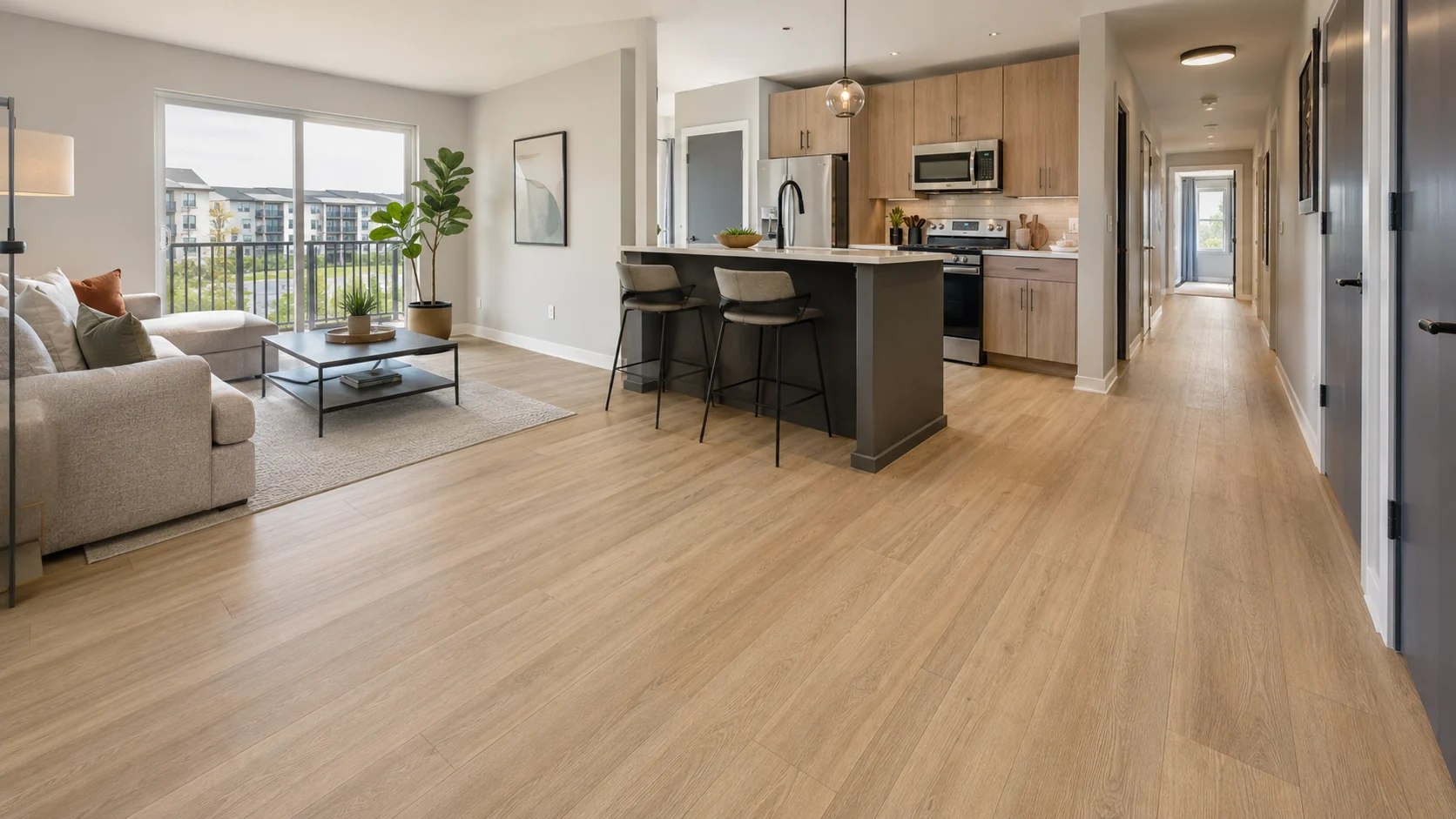
The reason why WPC flooring is chosen for multifamily apartments always remains the same. The flooring system needs to meet multiple criteria related to occupant comfort, sound performance, moisture resistance, quick turnover and reduced maintenance costs. The quality of flooring in multifamily buildings is not determined just by its aesthetics. The flooring should be able to withstand all kinds of activities – constant walking, furniture moving, cleaning, possible liquid spillage and even complaints from occupants living on the lower floor. The real question when choosing WPC flooring is not whether it is good, but rather if it fits the building.
Is WPC Flooring a Good Choice for Multifamily Apartments?
WPC flooring could prove to be a good option for many apartment units because it offers a resilient vinyl finish along with a composite core which is generally softer and less noisy compared to some other rigid core products. This makes it suitable for use in bedrooms, living rooms, upper levels, renter units, and renovation work.
WPC flooring has to be assessed on the basis of area since an individual apartment unit needs a different approach as compared to corridors, lobbies, laundry areas, and utility areas. The right product selection for a multifamily project usually varies on the basis of room type, behavior, cleaning process, and construction.
Where WPC Flooring Fits Best in Apartment Projects
The WPC Flooring option tends to be best for spaces occupied by people who need comfort, aesthetics, water resistance, and maintainability. Such rooms include the bedrooms, the living room, dining spaces, the leasing office, and some upper floor apartments. In such locations, people will be bothered by comfort and sound levels than would be the case in the warehouse like commercial space.
For the B2B customers, the choice process must begin with the project mapping. It entails figuring out which areas require quieter walkway, which areas have the problem of spills, which rooms need faster replacement and which floors are located above the occupied floors. The use of the WPC flooring in such a scenario can help decrease complaints and increase tenancy duration but its performance needs to be validated using the product specifications and the installation manual.
Where WPC Flooring May Not Be the Right Choice
WPC flooring is not intended to solve every application in the apartment building. Places where water stands frequently, rolling loads are high, subfloor moisture is intense, and traffic is extensive would benefit from a different system or added protection. An apartment building management changing the corridor flooring system will have to consider WPC alongside SPC, glue-down LVP, carpet tiles, or commercial vinyl.
The problem is using too much of WPC flooring in situations when the floor structure itself does not support the intended use of the floor. Buyers should check subfloor flatness, moisture content, load, cleaning agents, furniture loads, and if any local laws call for acoustic performance documentation before purchasing WPC flooring.
Sound Control: How WPC Flooring Helps Reduce Apartment Noise
Noise complaints are one of the most common flooring-related issues in multifamily housing. Residents may hear footsteps, dropped objects, chair movement, or airborne sound from nearby units. WPC flooring sound control can help in some cases, but it should be understood as part of a complete floor-ceiling assembly.
IIC and STC ratings are commonly used in acoustic discussions. IIC relates to impact noise, such as footsteps. STC relates to airborne sound, such as voices or television. These ratings are not only about the plank itself. They depend on the floor covering, attached pad, underlayment, subfloor, ceiling assembly, and test method.
Why Noise Complaints Happen in Multifamily Buildings
Apartment noise usually comes from a mix of structure and surface. A hard floor over a thin or poorly isolated assembly can transmit impact noise into the unit below. Loose subfloors, hollow spots, uneven surfaces, and incompatible underlayment can also create clicking, tapping, or drum-like sound.
For maintenance teams, the first step is to identify the source. Is the complaint about footsteps, squeaks, airborne noise, or vibration? Is it limited to one room or common across the building? If carpet was replaced with hard surface flooring, did the project also address acoustic underlayment and transition details? These questions help determine whether the problem is the flooring material, the installation, or the building assembly.
What IIC, STC and Underlayment Mean for WPC Flooring
When reviewing WPC flooring for upstairs apartments, buyers should ask for acoustic information that reflects a realistic assembly, not just a marketing claim. Attached IXPE or EVA backing may improve comfort and sound absorption, while additional underlayment may or may not be allowed depending on the product. Too much cushioning under a click-lock floor can cause joint stress, deflection, or warranty issues.
The practical procurement question is simple: what floor system was tested, and does it match the actual apartment project? If the test used a different slab, ceiling, underlayment, or plank thickness, the result may not translate directly. A supplier should be able to help buyers compare the flooring structure, backing, installation method, and intended room type before approval.
Waterproofing: What WPC Flooring Can and Cannot Solve
Waterproof WPC flooring is attractive for apartment buildings because spills, pet accidents, wet shoes, and kitchen moisture are common. Still, “waterproof flooring” should not be confused with a fully waterproof building system. The plank may resist water, but seams, wall edges, transitions, subfloor moisture, and installation workmanship still matter.
Moisture-Prone Areas: Kitchens, Entryways and Laundry Rooms
WPC flooring can be considered for apartment kitchens, entryways, and certain laundry-adjacent areas when the product specification supports that use. These spaces benefit from a surface that is easier to clean than carpet and less sensitive to routine spills than traditional wood-based flooring.
The limits should also be clear. WPC is not a substitute for drainage, waterproof membranes, or proper plumbing maintenance. If water is allowed to sit at seams or migrate under the floor, problems may appear over time. Buyers should confirm cleaning guidance, edge sealing requirements, expansion space, and whether the selected product is suitable for the expected moisture exposure.
Subfloor Moisture and Seam Risk in Apartment Renovations
Many multifamily projects involve renovation over concrete, plywood, or older flooring. Subfloor conditions can decide whether the installation succeeds. Moisture vapor from concrete, uneven slabs, old adhesive residue, or soft underlayment may affect click-lock performance and long-term stability.
Before installation, contractors should check flatness, moisture conditions, and compatibility with the selected installation method. For larger projects, it is also useful to document room conditions, product batch, acclimation requirements, and cleaning instructions. These records help reduce disputes if gaps, edge lifting, or joint noise appear after occupancy.
Maintenance and Tenant Turnover: Reducing Long-Term Operating Cost
For apartment operators, flooring cost is not only the purchase price. It includes cleaning labor, tenant damage, replacement time, vacancy days, and the ability to keep units visually consistent over multiple turnovers. WPC flooring maintenance should therefore be planned before the first order is placed.
Routine care usually includes sweeping or vacuuming abrasive dirt, damp mopping with suitable cleaners, and avoiding harsh chemicals that may damage the wear layer. The exact method should follow the product’s care instructions.
Cleaning and Daily Maintenance for Rental Units
WPC floors in rental units should be maintained with predictable, easy-to-train procedures. Maintenance teams need clear rules for move-out cleaning, stain removal, pet accident response, and furniture protection. Excess water, aggressive pads, solvent-based cleaners, or unapproved disinfectants may increase the risk of surface damage.
Procurement teams should ask for cleaning guidance during specification, not after installation. A low-maintenance floor is only useful if the property team knows how to care for it and if replacement materials remain available when damage occurs.
Replacement Planning: Spare Planks, Color Batches and Damage Control
Multifamily flooring projects benefit from spare material planning. Keeping extra planks from the same color and production batch can make future repairs easier. This is especially important when a unit has localized damage from furniture, appliances, pets, or water incidents.
Before ordering bulk WPC flooring for apartments, buyers should confirm plank size, locking profile, color name, surface texture, backing type, and whether future replenishment may vary by batch. For property portfolios, standardizing a limited range of colors and specifications can reduce maintenance confusion and speed up turnover.
WPC vs SPC, LVP and Carpet Tile for Multifamily Apartments
No single floor type fits every apartment project. WPC, SPC, glue-down LVP, and carpet tile each solve different problems. WPC tends to be considered when comfort and sound control matter. SPC may be preferred where rigidity and dent resistance are more important. Glue-down LVP can be practical for heavy traffic and direct subfloor bonding. Carpet tile can help with sound absorption but may create cleaning and stain concerns in rental units.
| Project Area | WPC Flooring | SPC Flooring | Glue-Down LVP | Carpet Tile |
|---|---|---|---|---|
| Upper apartment units | Strong for comfort and quieter walking | Moderate, depends on backing | Depends on assembly | Strong for impact sound |
| Kitchens and entries | Good when specifications allow | Strong | Strong | Usually weak |
| Public corridors | Project-dependent | Often strong | Often strong | Moderate |
| Fast unit turnover | Good with spare planks | Good with matching stock | Moderate | Good for tile replacement |
| Moisture-prone spaces | Good with proper detailing | Good | Good | Limited |
For apartment projects that need commercial WPC flooring options, Latitude Interiors provides a WPC flooring category that can support specification review before buyers narrow the choice to a single product.
WPC Flooring Procurement Checklist for Multifamily Projects
A good WPC flooring supplier should help buyers move from a general flooring idea to a project-ready specification. That means discussing use areas, installation method, surface texture, plank thickness, wear layer, backing, click system, cleaning method, and sample approval.
Latitude Interiors offers WPC flooring products that include customizable color and size options, multiple board thickness options, wear layer choices, surface textures such as wood grain and stone, UV coating, click system installation options, and IXPE or EVA backing options. These details should still be verified against the specific product page and the project’s use conditions.
Product Specifications to Request Before Quotation
Before requesting pricing, buyers should prepare a specification list. Important items include total project area, unit type, room locations, subfloor type, target thickness, wear layer, backing preference, installation method, acoustic requirement, moisture exposure, and expected maintenance routine.
For projects where click installation is important, a product such as click lock WPC flooring may be reviewed as a specification example. The final selection should depend on apartment area, acoustic needs, cleaning conditions, and installation guidance.
Questions to Ask a WPC Flooring Supplier
A supplier should be able to answer practical questions: Which WPC flooring is suitable for upper-level apartments? What backing options are available? Can samples be provided? What cleaning instructions should maintenance teams follow? Are color and size options available for project matching? What information is needed for quotation?
For buyers comparing suppliers, Latitude Interiors can be reviewed as a WPC, SPC, wall panel, flooring, and interior decoration product provider. More background is available through about Latitude Interiors, while project buyers can request WPC flooring specifications with area, size, application, quantity, and installation details.
Conclusion: Choosing WPC Flooring for Multifamily Apartments
WPC flooring can be a practical choice for multifamily apartments when the project needs a balance of sound control, waterproofing, comfort, and easier maintenance. The strongest applications are usually apartment living areas, upper-level units, rental renovations, and spaces where fast turnover matters. The risk comes from treating WPC as a one-size-fits-all product without checking acoustic requirements, moisture conditions, subfloor quality, and maintenance procedures.
For procurement, the next step is to submit the room type, project area, target thickness, installation method, subfloor condition, sample request, expected quantity, and any acoustic or waterproofing requirements. A supplier can then help match the specification to the building instead of forcing a generic product into the wrong use case.
FAQs
Can WPC flooring work well for multifamily apartment buildings?
Yes, WPC flooring is appropriate for most multifamily apartment units when comfort, quiet walking, waterproof flooring, and easy maintenance are priorities. The appropriateness of WPC flooring depends on the space, subfloor, traffic volume, acoustic requirements, and WPC flooring type.
Will WPC flooring lessen noise between floors of apartment buildings?
WPC flooring can help minimize walking noise and provide better comfort to walk on when it’s installed with proper backing or underlayment. However, IIC and STC ratings depend on the entire assembly of floor and ceiling, not individual planks.
Is WPC flooring sufficient for kitchens and laundry rooms in apartments?
It may be appropriate for kitchens, entryways, and adjacent laundry rooms when the standing water and plumbing problems are solved, but seams, edges, transitions, and moisture in the subfloor should also be taken into consideration.
What should buyers ask before ordering WPC flooring for apartment projects?
Buyers should ask about thickness, wear layer, backing, click system, surface texture, installation method, cleaning guidance, acoustic information, samples, batch consistency, and suitability for each apartment area.
Should multifamily projects choose WPC or SPC flooring?
WPC may be better when comfort and sound control are priorities. SPC may be more practical where rigidity and dent resistance are more important. The right choice depends on traffic, moisture exposure, acoustic needs, installation method, and maintenance plan.