
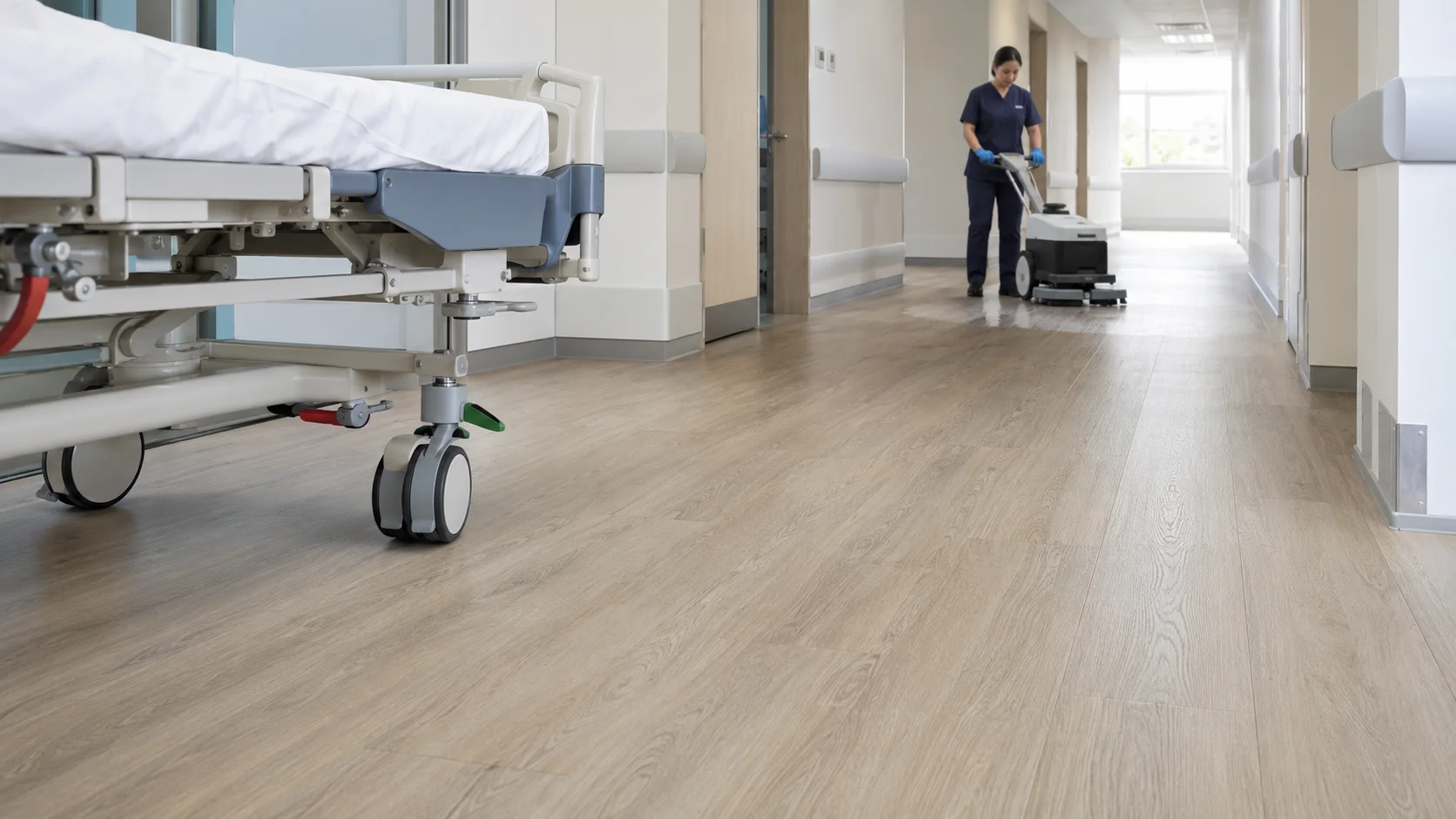
Flooring made from SPC for medical facilities will be selected when the need arises for a floor that can withstand daily cleaning, heavy traffic, wheeled equipment, and controlled budgets for construction projects. It is not only about asking whether it can be used in hospitals; it is more about knowing where it can best fit in and the type of conditions to expect before making a purchase.
Healthcare flooring decisions carry more risk than ordinary commercial interiors. A product that works well in an office may perform differently under hospital beds, wheelchairs, cleaning machines, disinfectants, moisture, and constant traffic. For B2B buyers comparing SPC flooring products for commercial projects, the selection process should focus on application area, installation conditions, slip resistance, surface durability, cleanability, and supplier documentation.
Is SPC Flooring Suitable for Hospitals and Healthcare Facilities?
SPC flooring can be good for numerous healthcare facilities, particularly those where the team requires durable rigid core vinyl flooring, maintenance ease, and variety of decorative options. Usually, it is chosen for use in medical offices, clinics, consulting rooms, waiting rooms, corridors, patient rooms, and staff areas where the infection control requirement does not match the level required in operating rooms or other sterile environments.
The key point that pushes buyers towards hospital SPC flooring is the fact that the building in question needs to have surfaces that are cost-effective, durable, good-looking, and fast-replaced. In addition, renovation professionals may want to install flooring that allows sectional installation without stopping the operation of the facility. However, in the end, one should consider the exact purpose of the room, its cleaning routine, the rolling equipment used there, subfloor condition, and other specific requirements.
Where SPC Flooring Works Well in Healthcare Projects
SPC flooring usually works best in healthcare areas where the floor must resist daily wear but does not need to act as a fully seamless clinical surface. Hospital corridors, outpatient clinics, rehabilitation areas, reception areas, administrative offices, waiting rooms, and some patient rooms are common examples. In these spaces, buyers usually care about wear resistance, slip resistance, dimensional stability, cleaning convenience, and visual consistency across a project.
For a hospital corridor, the key issue is rolling movement. Beds, service carts, wheelchairs, and cleaning equipment can follow the same path every day. For a clinic or medical office, the priority may be easy cleaning, a professional appearance, and enough surface durability for chairs, carts, and patient flow. In both cases, the buyer should confirm board thickness, wear layer, backing option, surface texture, installation method, and whether the supplier can provide the specification details needed for project approval.
Where SPC Flooring Should Be Used Carefully or Avoided
SPC flooring must be used judiciously where the hygiene criteria hinge upon a seamless, welded or cove base. Areas such as surgical suites, operating rooms, intensive care units, procedure rooms and constantly wet areas could need flooring that would cater to infection control or fluid containment. The issues here are not only that of the material, but of the planks, joints, transitions, walls and possibility of the fluid reaching the joints over time.
Where there is likely to be standing water, harsh chemicals, excessive load or very stringent sterile room requirements, the design team needs to compare SPC flooring with welded sheet vinyl, rubber, resin flooring or other types of healthcare flooring. Procurement of an appropriate flooring starts with categorizing the room first and then matching the flooring material according to the risk. Not just selecting the flooring due to the “hospital grade” nomenclature of the product.
Key Performance Requirements for Healthcare SPC Flooring
Healthcare SPC flooring should be evaluated by performance conditions, not by appearance alone. The most important checks are slip resistance, hygiene and cleanability, rolling load behavior, chemical resistance, indentation risk, and installation stability. These factors often matter more than color or plank pattern in a B2B project.
A specification sheet should be reviewed before purchase, and any unclear claim should be verified with the supplier. Terms such as “anti-slip,” “antibacterial,” “waterproof,” and “commercial grade” can mean different things depending on product construction, surface finish, test method, and application area.
Slip Resistance: Reducing Fall Risk in Wet and High-Traffic Areas

Hospital flooring slip resistance matters because healthcare environments combine fast movement, vulnerable patients, spills, wet cleaning, and wheeled equipment. Entry areas, corridors, nurse stations, restrooms nearby, and treatment support areas may become slippery after mopping or when people track in moisture. SPC flooring with a suitable surface texture can help reduce slip risk, but the correct choice depends on the wet/dry condition and the cleaning method.
A buyer should confirm whether the surface texture is appropriate for both traction and maintenance. A very smooth surface may be easier to wipe but less suitable for wet traffic. A deep texture may improve grip but collect residue if cleaning procedures are weak. For procurement, ask for available slip resistance information, surface finish details, recommended cleaning methods, and whether the product has been used in comparable commercial or healthcare spaces. For projects where anti-slip performance is a priority, anti-slip waterproof SPC flooring can be reviewed as a relevant product direction before requesting samples.
Hygiene and Cleanability: What SPC Can and Cannot Solve
Healthcare buyers often inquire about the hygiene capability of SPC floors. The practical response relies on the condition of the surface, the joints, proper installation and maintenance. The wear layer on SPC flooring is non-porous and may be appropriate for regular cleaning in a variety of healthcare environments. This product would be ideal for a medical office, waiting area, hallway and consultation room that undergoes regular cleaning without requiring a completely seamless surface.
It would not be appropriate to call SPC flooring an infection control floor for every application. Poorly installed plank seams, poor wall joints, poor door threshold transitions and worn edges may create problem areas when installing this floor in a space unsuited for its use. Buyers should ensure they know how the floor will be maintained, whether disinfectants are regularly used, whether liquids remain on the floor surface and whether the space requires coving the wall surface. In a setting that needs a truly monolithic surface, another type of floor might be better suited.
Rolling Loads: Hospital Beds, Wheelchairs, Carts and Cleaning Machines
Healthcare flooring rolling loads are a major reason buyers compare SPC flooring with other commercial flooring options. Hospital beds, wheelchairs, medication carts, imaging support equipment, and auto-scrubbers can place repeated stress on the same floor paths. Even if the surface looks strong, failure can happen through indentation, edge damage, joint movement, telegraphing from an uneven subfloor, or premature wear in traffic lanes.
To judge whether SPC flooring can handle hospital beds or carts, the buyer should look beyond the product image. Important questions include: What is the expected rolling equipment? Are the wheels hard or soft? Will equipment turn sharply in one area? Is the subfloor flat enough? Is glue-down, loose lay, or click installation more appropriate? Are transitions low and stable enough for wheelchairs and beds?
Rolling load performance may vary by board thickness, core construction, wear layer, installation method, and subfloor preparation. For high-traffic healthcare corridors, specification review and sample testing under realistic conditions are more useful than relying on a generic “commercial use” label.
Cleaning Chemicals: Disinfectants, Stains and Surface Durability
Hospital flooring cleaning chemicals can affect surface appearance and service life. Many healthcare facilities use neutral cleaners, disinfectants, quaternary ammonium products, diluted bleach, hydrogen peroxide-based cleaners, or other site-specific chemicals. SPC flooring may be suitable for routine cleaning, but chemical compatibility should be checked against the product specification and maintenance guide.
The common risks are dulling, discoloration, sticky residue, surface film, coating damage, and reduced slip performance after repeated chemical exposure. A floor can also become slippery if cleaning products are not diluted correctly or if residue builds up. Before buying SPC flooring for clinics or hospitals, procurement teams should provide the supplier with the cleaning chemicals used on site, cleaning frequency, equipment type, and whether the floor will be exposed to bodily fluids, iodine, alcohol, or other staining agents.
How to Specify SPC Flooring for Healthcare Facilities
A clear specification helps prevent misunderstandings between the buyer, contractor, supplier, and facility manager. Instead of asking only for “hospital SPC flooring,” the RFQ should describe the application area, traffic level, rolling loads, cleaning routine, installation method, target size, preferred thickness range, required documents, and sample requirements.
SPC flooring procurement is easier when the buyer separates mandatory requirements from preferences. Mandatory items may include slip resistance, fire-related documentation, wear layer, installation type, and cleaning compatibility. Preferences may include color, plank size, backing foam, texture, and budget range.
Thickness, Wear Layer and Surface Texture Selection
Thickness and wear layer are not the same thing. Total board thickness affects rigidity, feel, transition height, and installation behavior. Wear layer affects surface durability under foot traffic, cleaning, chairs, and wheeled movement. Surface texture affects slip resistance, cleaning effort, and appearance. In healthcare projects, these three choices should be reviewed together.
For light-use medical offices, a standard commercial SPC construction may be enough if cleaning is moderate and rolling loads are limited. For corridors, waiting areas, and zones with frequent carts, a stronger specification may be needed. Buyers should confirm available thickness options, wear layer thickness, surface texture, backing foam, plank size, and recommended use areas. If the product will be installed across a large project, request samples from the intended production batch or confirm how color and surface consistency are controlled.
Installation Method, Subfloor Flatness and Transition Details
Installation conditions can decide whether SPC flooring performs well in healthcare facilities. Even a suitable product can fail if the subfloor is uneven, damp, dusty, or unstable. Rolling loads make this more important because wheels can stress joints, edges, and transitions. Doorways, ramps, elevator areas, nurse station turns, and bed routes should be reviewed before final material approval.
Buyers should ask whether the product is designed for click, glue-down, loose lay, or dry back installation, and which method is recommended for the specific healthcare area. Subfloor flatness requirements, moisture limits, adhesive compatibility, expansion gaps, and transition accessories should be discussed before purchase. For replacement projects, the old floor condition and downtime requirements should also be part of the procurement conversation.
SPC Flooring vs Other Hospital Flooring Options
SPC flooring is one option within a larger healthcare flooring decision. It should be compared with sheet vinyl, rubber, resin flooring, and other resilient flooring systems based on the room’s function. The table below helps clarify where SPC may fit and where another system may deserve priority.
| Flooring Type | Better-Fit Healthcare Areas | Key Advantage | Main Procurement Caution |
| SPC flooring | Corridors, clinics, waiting areas, patient rooms, medical offices | Rigid core structure, design flexibility, practical replacement | Seams and transitions must match hygiene and traffic needs |
| Sheet vinyl | Areas needing fewer seams or welded installation | Better for continuous surface requirements | Installation skill and subfloor preparation matter |
| Rubber flooring | Staff-intensive areas, some corridors, comfort-focused spaces | Comfort underfoot and traffic resistance | Cost, maintenance routine, and chemical compatibility vary |
| Resin flooring | Labs, back-of-house clinical areas, high chemical exposure zones | Monolithic surface and chemical resistance options | Installation downtime and substrate preparation can be demanding |
This comparison should not be used as a universal rule. The right floor depends on room type, cleaning procedures, budget, load conditions, and facility standards. For healthcare renovation, the best next step is usually to classify rooms by risk level before choosing material.
Procurement Checklist Before Buying SPC Flooring for a Healthcare Project
A strong RFQ reduces the risk of buying the wrong material. Before contacting a hospital SPC flooring supplier, collect the following information:
- Project type: hospital, clinic, medical office, rehabilitation center, or dental facility
- Area of use: corridor, waiting area, patient room, office, restroom-adjacent zone, or support space
- Traffic level: staff, patients, visitors, beds, wheelchairs, carts, cleaning machines
- Cleaning chemicals: neutral cleaner, disinfectant, bleach solution, peroxide cleaner, or other products
- Installation condition: new build, renovation, subfloor type, moisture concerns, downtime limits
- Product requirements: thickness, wear layer, backing, texture, plank size, color, fire-related documents, sample needs
- Commercial details: target quantity, packaging needs, project schedule, destination, and after-sales expectations
What to Ask a Healthcare SPC Flooring Supplier
A qualified supplier should be able to discuss the flooring application rather than only quote a unit price. Ask whether the product is suitable for the intended healthcare area, what specification documents are available, which cleaning methods are recommended, and whether samples can be provided for review. If rolling loads are important, ask how the installation method and subfloor condition affect performance.
Latitude Interiors Limited specializes in the research, development, and production of WPC, SPC solid core wall panels, flooring, and overall home decoration materials. Buyers reviewing company background, production focus, and product categories can start from About Latitude Interiors Limited before preparing a project RFQ.
Red Flags When Comparing “Hospital Grade” SPC Flooring
“Hospital grade” is not enough by itself. A product title may include anti-slip, antibacterial, waterproof, or commercial use, but the buyer still needs to check the specification. Red flags include vague performance claims, no clear application guidance, no maintenance recommendation, no sample review, and no discussion of where the product should not be used.
Another warning sign is a supplier that presents SPC flooring as suitable for every healthcare room. A more reliable discussion will separate medical offices and corridors from sterile or high-risk clinical spaces. It will also address rolling loads, chemical exposure, installation method, and cleaning procedures before recommending a product.
Conclusion
SPC flooring for hospitals and healthcare facilities can be a practical choice when the application is matched to the right room type, traffic level, cleaning routine, and installation condition. It is especially relevant for corridors, clinics, waiting areas, medical offices, and selected patient areas where buyers need commercial SPC flooring with slip resistance, cleanability, and resistance to daily wear.
For procurement, the safest path is to define the room category first, then confirm slip resistance, rolling load conditions, cleaning chemical compatibility, board construction, surface texture, installation method, and supplier documentation. Latitude Interiors provides SPC flooring categories and relevant product options for commercial project review through Latitude Interiors and its SPC flooring product pages.
For project-specific support, submit the application area, target quantity, required size, preferred material or surface, cleaning chemicals, rolling equipment, installation method, drawings if available, and sample requirements through contact Latitude Interiors. Clear project information allows the supplier to respond with more relevant specifications instead of a generic product suggestion.
FAQs
Can SPC flooring be used in hospitals?
Yes, SPC flooring can be used in many hospital and healthcare areas, including corridors, clinics, waiting rooms, medical offices, and selected patient rooms. It should be specified carefully in operating rooms, ICUs, procedure rooms, and areas requiring fully welded or coved flooring systems.
Is SPC flooring good for hospital corridors?
SPC flooring may be suitable for hospital corridors if the specification matches the traffic level. Buyers should confirm wear layer, surface texture, rolling load conditions, subfloor flatness, installation method, and transition details before purchasing.
Can SPC flooring handle wheelchairs and hospital beds?
SPC flooring may handle wheelchairs, carts, and hospital beds when the product construction, installation method, and subfloor condition are appropriate. The expected wheel type, turning areas, repeated traffic paths, and point loads should be reviewed with the supplier.
What cleaning chemicals are safe for SPC flooring in healthcare facilities?
Safe cleaning chemicals depend on the product surface and maintenance guide. Before purchase, buyers should confirm compatibility with the facility’s neutral cleaners, disinfectants, diluted bleach, peroxide cleaners, or other chemicals used in daily cleaning.
How do I choose an SPC flooring supplier for a healthcare project?
Choose a supplier that can discuss application areas, specifications, samples, cleaning requirements, installation conditions, and procurement details. For healthcare projects, the supplier should help confirm where SPC flooring is suitable and where another flooring system may be safer.